

Urban Indigenous Community Conversations Aim to Make Treatment More Accessible
Urban Indigenous Community Conversations Aim to Make Treatment More Accessible
Urban Indigenous Community Conversations Aim to Make Treatment for Substance Use Disorders More Accessible to Western New York’s Indigenous Population
According to the Substance Abuse and Mental Health Services Administration (SAMHSA), American Indian/Alaska Natives (AIAN) experience the highest rates of substance use disorders (SUD) of any racial or ethnic group in the United States. This is linked to numerous individual, community, and structural risk factors, including historical trauma, and resulting in poverty and mental illness. Community stigmatization surrounding SUD is a significant barrier that hinders treatment-seeking behavior, sobriety, and ongoing recovery within AIAN populations.
To address these differences, Seneca Scientific Solutions+ and University of Rochester Medicine’s Recovery Center of Excellence partnered to develop and deliver “Indigenous Community Conversations” to rural Indigenous populations. Now, thanks to a Pilot Award granted by the Center for Community Health & Prevention’s Office of Health Equity Research (OHER), the research continues in 2026 with a new geographic focus.*
“Currently, 70% of Natives live in urban areas,” explained Dean S. Seneca, CEO of Seneca Scientific Solutions+ and principal investigator for the project. “Because Urban Indians suffer from significant health disparities and do not have the support of a traditional cultural community environment, their hardships are intensified.”
Research suggests that Urban Indigenous populations present a greater risk for substance use, gang activity, serious mental illness, suicide, and adverse childhood experiences, specifically abuse and neglect. “Urban Indians face unique challenges, including potentially greater psychological difficulties related to identity and belonging, racialized adversity, and intensified hardships due to the lack of traditional community health structures, all while experiencing greater health disparities, including high rates of SUD and related mortality,” said Seneca.
Despite these heightened risks, access to appropriate, culturally relevant treatment remains limited for urban Indigenous people. The Urban Indigenous Community Conversations (UICC) project aims to cultivate a safe space where Indigenous individuals can explore their attitudes, beliefs, and behaviors related to substance use as part of a supportive community.
“Initiatives like Urban Indigenous Community Conversations create space for healing, connection, and culturally grounded dialogue,” shared Edith Williams, PhD, MS, director of the Center for Community Health & Prevention and founding director of the OHER. “Pilot funding helps make this possible by fostering community partnerships, building trust, and developing programs that are both responsive and sustainable.”
Funding Shortfalls Leave Urban Indigenous Communities Lacking Services
Prior research has demonstrated that facilitating social connection between Indigenous individuals with and without SUD effectively reduced stigma in rural settings, with approximately 50% of workshop participants reporting improvements in attitudes, stigmatized beliefs, and behavioral intentions. However, this prior work was restricted by funding guidelines to address rural communities only.
The Urban Indigenous Community Conversations project addresses the urgent need for culturally adapted interventions tailored to urban AI/AN communities. Building upon the success of the rural model, the overall objectives of the project are to:
- Modify Indigenous Community Conversations to be applicable for urban Indigenous populations.
- Use the resulting model to reduce stigma surrounding treatment for substance use disorders and encourage support-seeking behavior among American Indian/Alaska Natives living in urban areas.
“Our primary hypothesis is that participants who attend the Urban Indigenous Community Conversations Workshop will report positive shifts in their attitudes, beliefs, and behavioral intentions in seeking treatment for SUD,” said Seneca. “The long-term goal is to increase the number of urban Indigenous peoples who pursue treatment in Western and Central New York.”
Survey Now Available
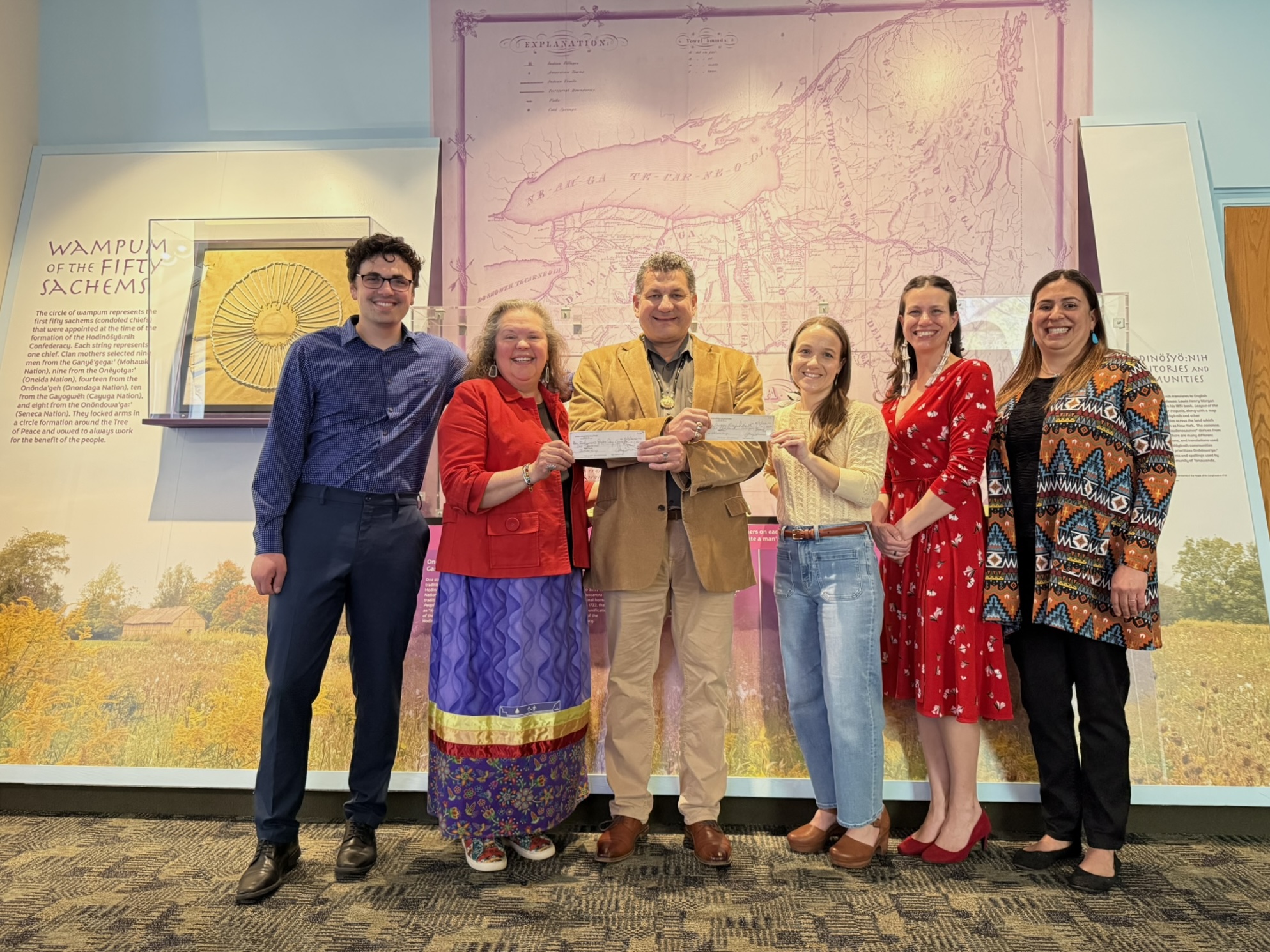 Dean Seneca presents a $1,000 check to the Indigenous Peoples’ Day Committee and Common Ground Health’s Indigenous Health Coalition for their support of outreach and recruitment among the local urban Indigenous population.To assess the burden of SUDs among Indigenous people in Rochester and adjacent urban settings, Dean Seneca is working with the Indigenous Peoples’ Day Committee and Common Ground Health’s Indigenous Health Coalition to support outreach and recruitment among Indigenous populations in Rochester, Buffalo, Syracuse, and Niagara Falls. Since many community members may live and work across these neighboring urban settings, this regional perspective will bolster an understanding of urban Indigenous stigma against SUD that can be tailored to the Rochester community with a more comprehensive cultural lens.
“This will enable us to develop targeted strategies and resources that resonate with the Urban Indian community’s lived experiences and foster a more inclusive and supportive workshop for participants,” noted Seneca. “We believe that by gathering data directly from our Urban areas in Central and Western New York, we will identify the most relevant topics for the Urban Indigenous Community Conversations Workshop. We will evaluate how workshop participants perceive stigma, how this has impacted their treatment-seeking behaviors, and if they have helped others access treatment.”
The current hypothesis is that workshop participants will show at least a 25 percent increase in positive perceptions of stigma, seeking SUD treatment themselves, and aiding others to get treatment.
“We will tailor the portrayal of addiction issues to reflect the realities and nuances identified in the survey responses. These adaptations will ensure that the Urban Indigenous Community Conversations Workshop is culturally sensitive, contextually appropriate, and effectively addresses the unique needs of the AI/AN community, thereby enhancing its potential to reduce stigma and promote SUD treatment,” concluded Seneca.
The survey is available online and is set to close on Tuesday, June 30, 2026.
All individuals connected to urban Indigenous communities in Rochester, Buffalo, Syracuse, and Niagara Falls are encouraged to participate, including those who live, work, receive services, or have strong ties to these communities. Participation is also welcomed from healthcare and substance use disorder (SUD) treatment providers, as well as others who support or collaborate with Indigenous patients and clients in these areas.
*All investigators affiliated with OHER as a Health Equity Research Core Investigator were eligible to apply for and receive OHER pilot funding, regardless of race, color, religion, sex, national origin, age, and any other protected classes under current federal anti-discrimination policies. Research involving all populations was considered.