

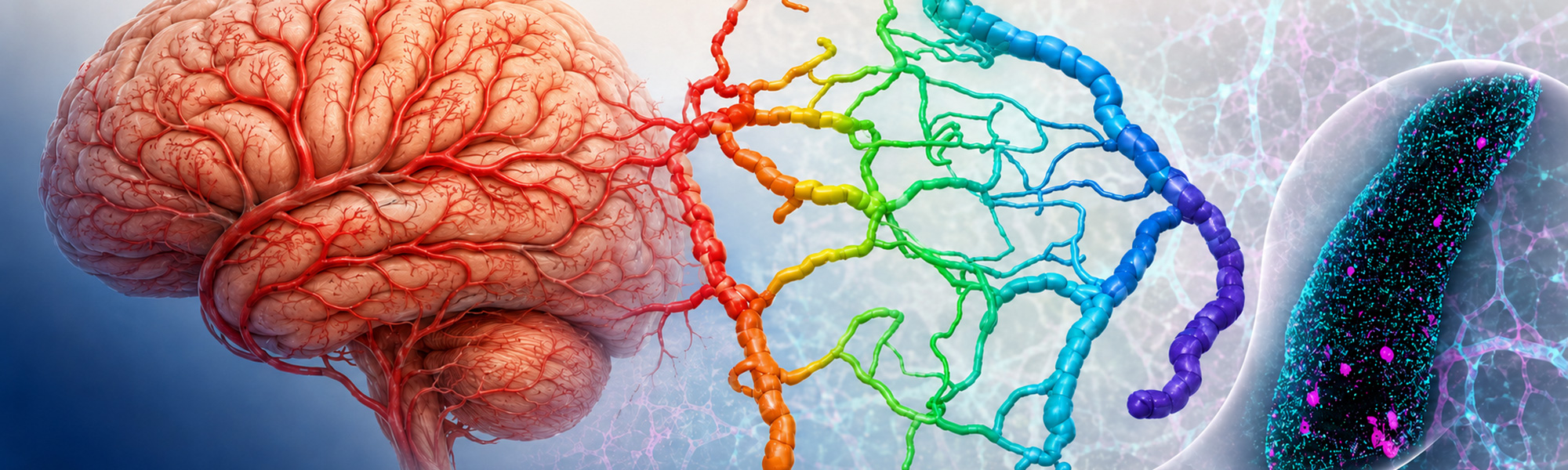
From Capillaries to Cognition
The Earley Laboratory investigates how the cerebral microcirculation regulates blood flow and supports brain function. Our research focuses on the ion channels and intercellular signaling pathways that coordinate communication among endothelial cells, vascular smooth muscle cells, pericytes, astrocytes, and neurons. We seek to understand how these cellular networks control neurovascular coupling, cerebral blood-flow autoregulation, and other fundamental aspects of cerebrovascular physiology.
A major goal of our program is to determine how disruption of microvascular signaling contributes to cognitive decline and dementia. We study the effects of aging, Alzheimer’s disease, and genetic cerebral small-vessel diseases on vascular function and brain health. By integrating in vivo imaging, vascular physiology, electrophysiology, calcium imaging, molecular genetics, super-resolution microscopy, and behavioral analysis, we connect molecular and cellular mechanisms to whole-brain function.
Our long-term objective is to identify new therapeutic targets that preserve cerebral blood flow, protect the neurovascular unit, and reduce the burden of cerebrovascular disease and dementia.

Scott Earley, Ph.D.
Principal Investigator
Publications
ORCID: 0000-0001-9560-2941
Lavanderos, B., A. Sanchez-Solano, W. Zhu, P. Thakore, E. Yamasaki, Y. F. Earley, M. Trebak, and S. Earley. STIM1 and ORAI1 Ca2+ Channels Drive Capillary-to-Arteriole Communication in Neurovascular Coupling. Sci. Signaling, 2026, (in press).
Zhu W., A. Sanchez–Solano, B. Lavanderos, S. Pan, Y. F. Earley, and S. Earley. TRPM4 Couples Mechanical Force to Myogenic Constriction Throughout the Resistance Vasculature. bioRxiv [Preprint]. 2026 Jun 11:2026.06.08.731006. doi: 10.64898/2026.06.08.731006.
Metwally, E. A. Sanchez Solano, B. Lavanderos, E. Yamasaki, P. Thakore, C. McClenaghan, N. Rios, R. Radi, Y. Feng Earley, C. G. Nichols, and S. Earley. Mitochondrial Ca2+-coupled generation of reactive oxygen species, peroxynitrite formation, and endothelial dysfunction in Cantú syndrome. JCI Insight, 2024, Aug 1;9(17):e176212.
Yamasaki, E., P. Thakore, S. Ali, A. Sanchez Solano, X. Wang, X. Gao, C. Labelle-Dumais, M.M. Chaumeil, D. B. Gould, and S. Earley. Defective Ca2+- dependent activation of TRPM4 channels contributes to age-related cerebral small vessel disease in Col4a1 mutant mice. Sci. Signaling, 2023, Nov 14;16(811):eadi3966. PMID: 37963192.
Thakore, P. E. Yamasaki, S. Ali, A. Sanchez Solano, C. Labelle-Dumais, X. Gao, M. M. Chaumeil, D. B. Gould, and S. Earley. PI3K block restores age-dependent neurovascular coupling defects associated with cerebral small vessel disease. Proc. Natl. Acad. Sci. USA, 2023, 2023 Aug 29;120(35):e2306479120, PMID: 37607233.
Yamasaki, E., S. Ali, A. Sanchez Solano, P. Thakore, M. Smith, X. Wang, C. Labelle-Dumais, D. B. Gould, and S. Earley. Faulty TRPM4 channels underlie age-dependent cerebral vascular dysfunction in Gould syndrome Proc. Natl. Acad. Sci. USA, 2023 Jan 31;120(5):e2217327120. PMID: 36693102.
Krishnan, V., S. Ali, A. L. Gonzales, C. S. Griffin, P. Thakore, E. Yamasaki, M. G. Alvarado, M. Johnson, M. Trebak, and S. Earley. STIM1-Dependent Peripheral Coupling Governs the Contractility of Vascular Smooth Muscle Cells. eLife, 2022;11:e70278.
Thakore, P., M.G. Alvarado, S. Ali, A. Mughal, P.W. Pires, E. Yamasaki, H. A. T. Pritchard, B. Isakson, C. Ha Tran, and S. Earley. Brain Endothelial Cell TRPA1 Channels Initiate Neurovascular Coupling. eLife 2021;10:e63040.
Thakore, P., H. A. T. Pritchard, C. S. Griffin, E. Yamasaki, B. T. Drumm, C. Lane, K. M. Sanders, Y. Feng Earley, and S. Earley. TRPML1 Channels Initiate Ca2+ Sparks in Vascular Smooth Muscle Cells. Sci. Signaling, 13 (637), eaba1015, 23 June 2020. (Selected for the cover image).
Yamasaki, E., P. Thakore, V. Krishnan, and S. Earley. Differential Expression of Angiotensin II Type 1 Receptor Subtypes Within the Cerebral Microvasculature. Am. J. Physiol. (Heart Circ. Physiol.), 2020 Feb 1;318(2):H461-H469.
Pritchard, H.A.T., C. S. Griffin, E. Yamasaki, P. Thakore, C. Lane, A. S. Greenstein, and S. Earley. Nanoscale Coupling of Junctophilin-2 and Ryanodine Receptors Regulates Vascular Smooth Muscle Cell Contractility. Proc. Natl. Acad. Sci. USA, 2019, 116(43):21874-21881.
Pires, P.W. and S. Earley. Neuroprotective Effects of TRPA1 Channels in the Cerebral Endothelium Following Ischemic Stroke. eLife 2018;7: e35316.
Pritchard, H.A.T., P. W. Pires, E. Yamasaki, P. Thakore, and S. Earley. Nanoscale Remodeling of Ryanodine Receptor Cluster Size Underlies Cerebral Microvascular Dysfunction in Duchenne Muscular Dystrophy. Proc. Natl. Acad. Sci. USA, 2018 115 (41) E9745-E9752.
Pritchard, H.A.T., A.L. Gonzales, P.W. Pires, B.T. Drumm, E. Ko, K.M. Sanders, G.W. Hennig, and S. Earley. Microtubule Structures Underlying the Sarcoplasmic Reticulum Support Peripheral Coupling Sites Regulating Smooth Muscle Contractility, Sci. Signaling, 10 (497), eaan2694, 2017.
Pires, P.W., E. Ko, H.A.T. Pritchard, M. Rudokas, E. Yamasaki, and S. Earley. The Angiotensin Receptor type 1b is the Primary Sensor of Intraluminal Pressure in Cerebral Artery Smooth Muscle Cells, J. Physiology, 595(14):4735-4753, 2017.
Pires, P.W., F. Dabertrand, and S. Earley. Isolation and Cannulation of Cerebral Parenchymal Arterioles, J. Visualized Experiments, May 23; (111), 2016.
Pires, P.W. M.N. Sullivan, H.A.T. Pritchard, J.J. Robinson, and S. Earley. Unitary TRPV3 Channel Ca2+ Influx Events Elicit Endothelium-Dependent Dilation of Cerebral Parenchymal Arterioles. Am. J. Physiol. (Heart Circ. Physiol.), 309(12):H2031-41, 2015.
Sullivan M.N., A. L. Gonzales, P.W. Pires, A. Bruhl, M. D. Leo, W. Li, A. Oulidi, F.A. Boop, Y. Feng, J. H. Jaggar, D. G. Welsh, and S. Earley. Localized TRPA1 Channel Ca2+ Signals Stimulated by Reactive Oxygen Species Promote Cerebral Artery Dilation, Sci. Signaling, 8(358), 2015.
Gonzales, A.L., Y. Yang, M. N. Sullivan, L. Sanders, F. Dabertrand, D. C. Hill-Eubanks, M. T. Nelson, and S. Earley. A PLCγ1-dependent, Force-sensitive Signaling Network in the Myogenic Constriction of Cerebral Arteries. Sci. Signaling, 7(327), 2014.
Contact Us
Earley Lab
601 Elmwood Ave
Room 4-5512
Rochester, NY 14642