

REACH-DM Study
REACH-DM Study
Study Purpose
To better understand why myotonic dystrophy type 1 (DM1) affects people in so many different ways, even within one family. We will evaluate the effects of DM1 on muscle, heart, and nervous system and evaluate genetic differences in a blood sample. By better understanding disease variability, we aim to improve how we can counsel patients in clinic, make clinical trials more efficient, and potentially identify new targets for treatment.
Who Can Participate?
Everyone with myotonic dystrophy type 1 can participate.
What is Involved?
- There is no travel required. You can do the study from home. We will mail you a toolkit with everything you need to participate.
- Genetic testing is included. You can choose to have your genetic test result returned to you.
- One-on-one video calls with the myotonic dystrophy study team.
What Studies are Available?
REACH-DM (Original)
Ages: 18-88
Visit Length: ~2-3 hours
Visit Includes:
- A physical examination
- An interview to determine when you first developed symptoms
- An electrocardiogram (EKG)
- Several muscle strength and myotonia tests
- A blood collection
- Questionnaires
- A research genetic test and if you like, we will send a report to you with results
RAPID REACH-DM
Ages: 18-88
Visit Length: ~30 minutes
Your visit could include any of the above depending on time and ability but at a minimum includes grip strength testing and questions.
REACH-DM Kids
Ages: 0-18
Visit Length: ~2-4 hours
Visit Includes:
- A physical examination
- An interview with a parent or guardian to determine when you first developed symptoms
- An electrocardiogram (EKG)
- Several muscle strength and myotonia tests
- A blood collection
- Questionnaires
- A research genetic test and if you like, we will send a report to you with results
If you are interested, please call Jeanne Dekdebrun at (585) 276-4611 or Erin Richardson at (585) 275-0420, or email REACHDM@URMC.rochester.edu.
Project Updates and News
Going Green for International DM Awareness Day
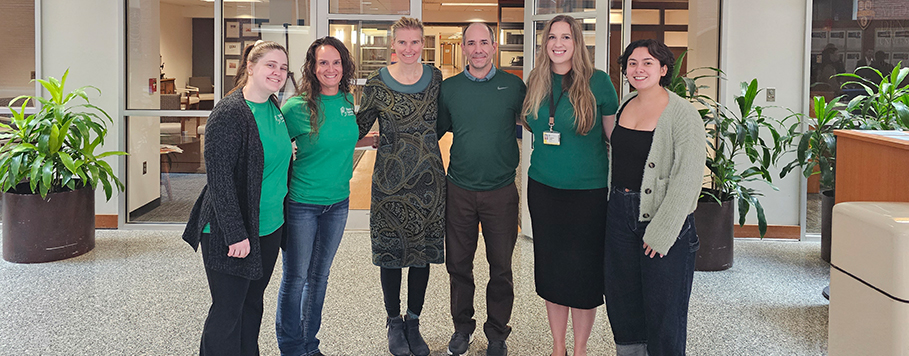
Our team wore green on September 15th to recognize Myotonic Dystrophy Awareness Day! We’re proud to stand together to raise awareness of myotonic dystrophy, support individuals and families affected by the disease, and highlight the importance of research and care.
Videoconferencing Makes DM1 Research Accessible and Reliable
A recent publication in Neurology, led by Johanna Hamel and the REACH DM study team, showed that tests of muscle strength, movement, function, and breathing can be performed reliably at home using videoconferencing in people with Myotonic Dystrophy Type 1 (DM1). Many people with DM1 live far from research centers, making participation in studies that require in-person visits difficult. In this study, forty individuals from several U.S. states completed the assessments from home, and 36% had never previously participated in a research study. Participants received a kit containing a tablet and testing devices and completed two video-supervised study visits within three months. During these visits, they performed assessments of hand strength and coordination, walking and mobility, and breathing function, some of which were recorded and later scored by multiple researchers. Most tests produced very consistent results when repeated, and several objective measurements aligned with participants’ reports of their daily physical function. These findings show that remote assessments for DM1 are feasible and reliable, and they may reduce travel burden while enabling broader participation in research.
Visiting Student Laura Tufano
 Laura Tufano is a neurologist and neuromuscular specialist. During her residency, her primary research interests were focused on muscle diseases, particularly Myotonic Dystrophy type 1. Her research explored muscle histology-MRI matching in muscle diseases and the development of outcome measures for Myotonic Dystrophy type 1. After completing her residency at Sapienza University of Rome in 2023, she transitioned into a PhD program to continue her research studies, under the mentorship of Dr. Matteo Garibaldi. Currently she is working on clinical research projects on Myotonic Dystrophy at the University of Rochester, where she is mentored by Dr. Johanna Hamel. She has been evaluating the test-retest reliability of remote functional assessments and sleep data collected through wearable devices as part of the REACH-DM project. In addition, Laura is focusing on Central Nervous System involvement of Myotonic Dystrophy as captured by the National Registry.