
Research
Resident Research and Scholarship
Whether part of an individual patient encounter or the implementation of a multicenter clinical trial, the practice of medicine requires curiosity and a scholarly, evidence-based approach. To help cultivate these skills, all residents participate in various forms of scholarly activity during residency.
- All residents complete a quality improvement project and formally present their work as a poster or oral presentation.
- All residents participate in a longitudinal Evidence Based Medicine curriculum during their ambulatory blocks and deliver a Journal Club.
- Any resident interested in pursuing basic science, clinical, public health, or educational research or other scholarly work during residency is encouraged to do so, and elective time can be used for those activities.
- Residents who wish to complete an ambitious research project during residency can participate in our Research Track to earn a Distinction in Research at the end of residency training. The Research Track is separate and distinct from the Physician Scientist Training Program, an accelerated ABIM-approved residency and fellowship combined training pathway with a separate NRMP number and application process.
Research Faculty, Electives, and Resources 
Dr. John Grable and Dr. Alec O’Connor are the Assistant Program Directors for Resident Research and Scholarship.
Dr. Grable oversees the Research Track. He also coordinates our Resident Poster Day, an annual city-wide event open to any Internal Medicine or Medicine-Pediatrics resident in Rochester that allows residents to showcase their scholarly work. Many residents who present at Poster Day go on to present their work at regional and national conferences, including American College of Physicians, American College of Cardiology, American Thoracic Society, Society of Hospital Medicine, and many others. Visit the DOM Resident Poster Day site to see the latest award winners and additional abstracts, presentations, and posters that were presented.
Dr. O’Connor oversees the Research electives, helping to ensure that residents make the most of this protected time. He is a great resource for helping residents develop research questions, design studies, create surveys, and connect with mentors.
- Research electives can be scheduled as traditional 2- or 4-week blocks of time, or residents can choose to replace a year-long ambulatory elective with a research elective (e.g., using a half-day per week during each of their ambulatory blocks over the course of the year for research rather than a subspecialty elective) in our block model.
- Preliminary residents may use a 2-week elective to pursue research rather than a specialty rotation. This block has been successfully used to start projects (e.g., design project and submit RSRB applications) that will then continue in their PGY2 and beyond.
The Department of Medicine offers numerous resources to support resident research and scholarship:
- Residents can use the Student/Trainee Research Form to help them connect with projects of interest and faculty mentors.
- Biostatics Support is available for residents engaged in mentored projects.
Residents with interest in educational scholarship may request a consult to help with project design and evaluation and can access the Medical Education Research and Scholarship Guide.
The Research Track
The Research Track provides an opportunity for interested residents to complete residency with distinction in research. Most residents with interest in the track begin planning a research project during their PGY1 year and have identified a mentor and prepared a formal proposal by the beginning of PGY2 year. If the project is approved, the resident may have up to 4 weeks of elective time in both their PGY2 and PGY3 years for focused work on their project. Residents may also have elective and administrative time during ambulatory blocks for their research. Successful completion of the track with the distinction in research designation requires:
- Preparation of a manuscript suitable to submit for publication.
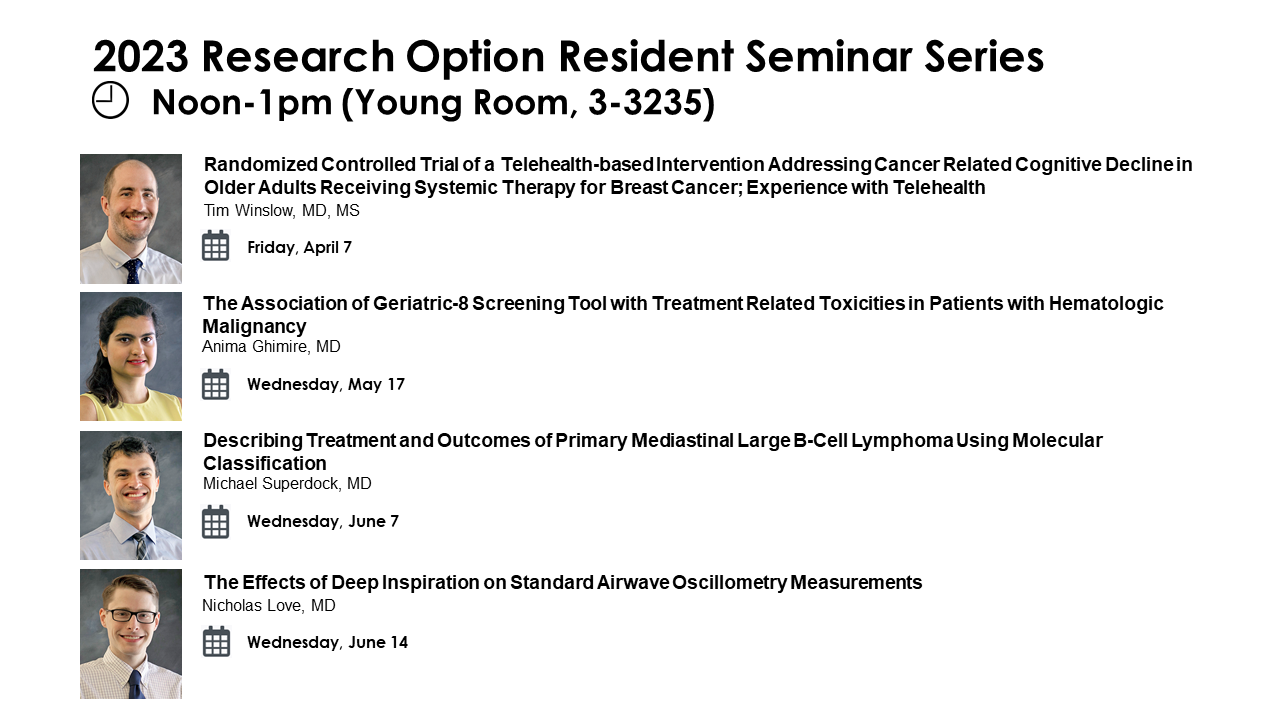
- Presentation of the completed project at a noon conference during the PGY3 year. The presentation will be attended and critiqued by a panel of faculty experts. Here are presentations from 2023, 2024, and 2025.

ROChester Stimulating Access to Research during Residency (ROC StARR)
In 2025, the Departments of Medicine, Pediatrics and Dermatology were awarded a prestigious NIH R38 grant that provides financial and mentoring support for residents to pursue an additional year of training focused on research (80% research/20% clinical) to study immune-related diseases. The goal of the ROC StARR program is to train a diverse pool of physician-scientists to lead the development, implementation, and evaluation of new approaches to diagnose, treat, and prevent autoimmune, allergic, inflammatory, and infectious diseases. The R38 grant will support resident investigators to engage in 1-2 years of 80% protected and mentored research time. They will craft a research plan based on their interests and prior experiences and engage in relevant coursework, workshops, and career development activities. The program will extend residency by a minimum of 12 months with the option for an additional 12 months of research, if desired.
