

Evolution and Development
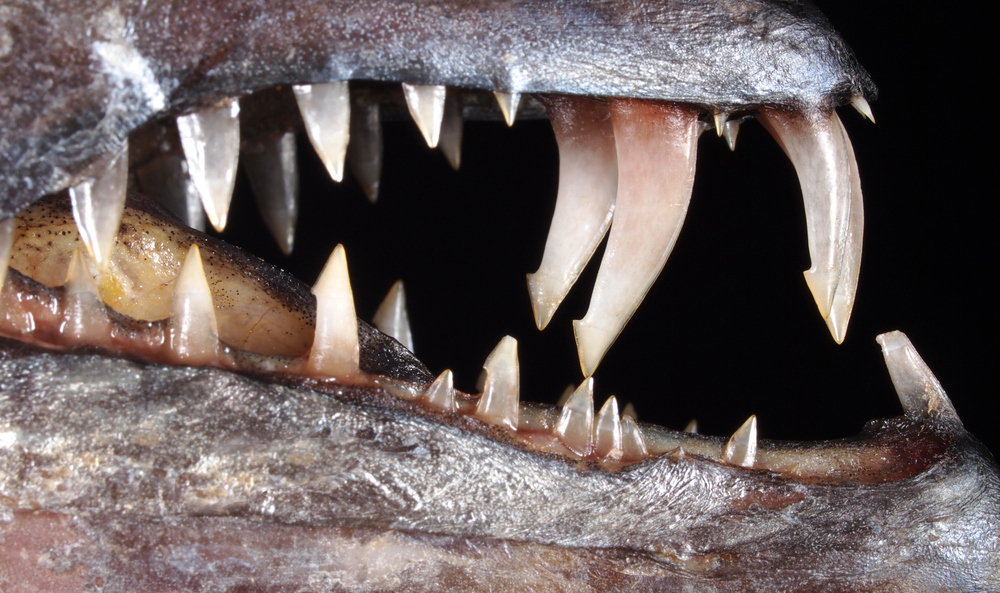
Typical teleost (fish) dentition
The craniofacial and odontogenic macro- and microanatomy of modern humans and other recent vertebrates has evolved over 500 millions of years beginning with the earliest vertebrates. Along this path, many human organs have first evolved in basal organisms, alongside other organs no longer found in humans. We study vertebrate evolution to understand the process by which human anatomy has evolved since its beginnings. Following comparative studies on tooth enamel in vertebrates (Diekwisch et al. 1995, Satchell et al. 2002, Diekwisch et al. 2002) we focused on tooth evolution in a number of link species, including cyclostomes and lungfishes (Slavkin and Diekwisch 1996, 1997, Satchell et al. 2000). These studies resulted in two major questions related to evolution of jaw apparatus function:
- How is the non-mineralized state of the periodontal attachment apparatus accomplished and maintained?
- How do amelogenin molecules evolve to modulate enamel physical properties?
To address the question of the non-mineralized state of the periodontal ligament, we compared Hertwig’s Root Sheath in vertebrates (Luan et al. 2006) and determined the mineralized state of crocodilian and Mosasaur periodontia (McIntosh et al. 2002, Luan et al. 2009). To understand amelogenin molecular evolution, we cloned and characterized a number of reptilian and amphibian amelogenin genes, including those of frogs, salamanders, and iguanas (Wang et al. 2005, Diekwisch et al. 2006, Wang et al. 2006, Diekwisch et al. 2009, Wang et al. 2014). Based on these studies, we established polyproline repeat elongation as a mechanism for amelogenin aggregate compaction and enamel crystal elongation (Jin et al. 2009, PLoS Biology). Using an evolutionary biology approach, we are now studying the relationship between the amelogenin molecule and enamel mechanical properties (Lucas et al. 2014).
Contributions to Journals
- Abramyan, J., Allan, M., Ding, Y., Lnu, N., Tang, L., Diekwisch, T.G.H. (2026). An Amelogenin Herbivore Motif, a Compacted Enamel Protein Matrix and Prismatic Enamel in Uromastyx Demonstrate Convergent Evolution in an Agamid Masticatory Apparatus. Evol. Dev. 28(2): e70043. Journal Cover.
- Shaheen, J., Mudd, A.B., Diekwisch, T.G.H., and Abramyan, J. (2021). Pseudogenized Amelogenin Reveals Early Tooth Loss in True Toads (Anura: Bufonidae). Integr Comp Biol. 61(5): 1933-1945.
- Diekwisch, T.G.H. (2020). Evolution: Herbivore-type teeth in a Cretaceous Tuatara.Curr Biol. 30(9): R395-R397.
- Diekwisch, T.G.H. (2016). Our periodontal tissue: a masterpiece of evolution. Clin. Periodontol. 43(4): 320-322.
- Liu, M., Reed, D.A., Cecchini, G., Lu X., Ganjawalla, K., Gonzales, C.S., Monahan, R., Luan X., and Diekwisch, T.G.H. (2016). Varanoid tooth eruption and implantation modes in a late Cretaceous Mosasaur. Front. Physiol. 7:145.
- Reed, D.A., Iriarte-Diaz, J., and Diekwisch, T.G.H. (2016). A three dimensional free body analysis describing variation in the musculoskeletal configuration of the cynodont lower jaw. Evol Dev. 18(1): 41-53.
- Mao, Y., Satchell, P.G., Luan, X., and Diekwisch, T.G.H. (2016). SM50 Repeat- Polypeptides self-assemble into discrete matrix subunits and promote appositional calcium carbonate crystal growth during sea urchin tooth biomineralization. Ann Anat. 203: 38-46.
- Gopinathan, G., Jin, T., Liu, M., Li, S., Atsawasuwan, P., Galang, M.T., Allen, M., Luan, X., and Diekwisch, T.G.H. (2014). The expanded amelogenin polyproline region preferentially binds to apatite versus carbonate and promotes apatite crystal elongation. Front. Physiol. 5: 430.
- Lucas, P.W., Casteren, A.v., Al-Fadhalah, K., Almusallam, A.S., Henry, A.G., Michael,S., Watzke, J., Reed, D.A., Diekwisch, T.G.H., Strait, D.S. and Atkins, A.G. (2014). The role of dust, grit and phytoliths in tooth wear. Annales Zoologici Fennici 51: 143-152.
- Lovaglio, J., Artwohl, J.E., Ward, C.J., Diekwisch, T.G.H., Ito, Y., and Fortman, J.D. (2014). Case study: polycystic livers in a transgenic mouse line. Comp. Med. 64(2): 115-120.
- Wang, X., Xing, Z., Zhang, X., and Diekwisch, T.G.H. (2013). Alternative splicing of the amelogenin gene in a caudate amphibian Plethodon cinereus. PLoS ONE 8(6):e68965.
- Smith, M.M., Johanson, Z, Underwood, C., and Diekwisch, T.G.H. (2013). Pattern formation in development of chondrichthyan dentitions: a review of an evolutionary model. Historical Biology 25: 127-142.
- Lu, X., Ito, Y, Kulkarni, A., Gibson, C., Luan, X., and Diekwisch, T.G.H. (2011). Ameloblastin-rich enamel matrix favors short and randomly oriented apatite crystals. Eur. J Oral Sci. 119(Suppl 1): 254-260. Journal Cover.
- Diekwisch, T.G.H. (2011). Evolution and ameloblastin. Eur J Oral Sci. 119(Suppl 1): 293-297.
- Jin, T.*, Ito, Y.*, Luan, X., Dangaria, S., Walker, C., Allen, M., Kulkarni A., Gibson, C., Braatz, R., Liao, X., and Diekwisch, T.G.H. (2009). Supramolecular compaction through polyproline motif elongation as a mechanism for vertebrate enamel evolution. PLoS Biology 7(12): e1000262. Featured in Science: ScienceNOW/ScienceShots December 2009.
- Diekwisch, T.G.H., Jin, T., Wang, X., Ito, Y., Schmidt, M.K., Druzinsky, R., Yamane, A., and Luan, X. (2009). Amelogenin evolution and tetrapod enamel structure. Front. of Oral Biol. 13: 74-79.
- Luan, X., Walker, C., Dangaria, S., Ito, Y., Druzinsky, R., Jarosius, K., Lesot, H., and Rieppel, O. (2009). The mosasaur tooth attachment apparatus as paradigm for the evolution of the gnathostome periodontium. Evol. Dev. 11(13): 247-259.
- Luan, X., and Diekwisch, T.G.H. (2007). Vienna - Chicago: the cultural transformation of the model system of the un-opposed molar. Bioessays 29(8): 819-830.
- Wang, X., Fan, J.-L., Ito, Y., Luan, X., and Diekwisch, T.G.H. (2006). Identification and characterization of a squamate reptilian amelogenin gene: Iguana iguana. J. Exp. Zool. Mol. Dev. Evol. 306(4): 393-406.
- Diekwisch, T.G.H., Wang, X., Fan, J.-L., Ito, Y., and Luan, X. (2006). Expression and characterization of a Rana pipiens amelogenin protein. Eur. J. Oral Sci. 114 Suppl 1: 86-92.
- Luan, X., Ito, Y., and Diekwisch, T.G.H. (2006). Evolution and development of Hertwig’s Epithelial Root Sheath. Dev. Dyn. 235(5): 1167-1180.
- Wang, X., Ito Y., Luan, X., Yamane, A., and Diekwisch, T.G.H. (2005). Amelogenin sequence and enamel biomineralization in Rana pipiens. J. Exp. Zool. Mol. Dev. Evol. 304(2):1-10.
- McIntosh J.E., Anderton, X., Flores-de-Jacoby, L., Carlson D.S., Shuler C.F., and Diekwisch, T.G.H. (2002). The caiman periodontium as an intermediate between basal vertebrate ankylosis-type attachment and mammalian “true” periodontium. Microsc Res Tech. 59(5): 449-459.
- Diekwisch, T.G.H., Berman, B.J., Anderton, X., Gurinsky, B., Ortega A.J., Satchell P.G., Williams, M., Arumugham C., Luan X., McIntosh J.E., Yamane A., Carlson, D.S., Sire, J.-Y., Simmer J.P., and Shuler, C.F. (2002). Membranes, minerals, and proteins of developing vertebrate enamel. Microsc Res Tech. 59(5): 373-395.
- Satchell, P.G., Anderton, X., Ryu, O.H., Luan, X., Ortega, A.J., Opamen, R., Berman, B.J., Witherspoon, D.E., Gutmann, J.L., Yamane, A., Zeichner-David, M., Simmer, J.P., Shuler, C.F., and Diekwisch, T.G.H. (2002). Conservation and variation in enamel protein distribution during tooth development across vertebrates. Mol. Dev. Evol. J. Exp. Zool. 294(2): 91-106.
- Diekwisch, T.G.H. (2002). Introduction. Development and Histochemistry of Vertebrate Teeth. Microscopy Research Technique 59: 339-341.
- Satchell, P.G., Shuler, C.F., and Diekwisch, T.G.H. (2000). True enamel covering in teeth of the Australian lungfish Neoceratodus forsteri. Cell Tissue Res. 299(1): 27-37. Journal Cover.
- Slavkin, H.C. and Diekwisch, T.G. (1997). Molecular strategies of tooth enamel formation are highly conserved during vertebrate evolution. Ciba Found Symp. 205: 73-80.
- Slavkin, H.C. and Diekwisch, T. (1996). Evolution in tooth developmental biology: of morphology and molecules. Anat. Rec. 245(2): 131-150.
- Diekwisch, T.G.H., Marches, F., Spears, R., and Dechow, P. (1995). Effect of enamel protein expression on enamel crystal formation: a phylogenetic study. R.J. Radlanski and H. Renz (Eds.) Proc. 10th Int. Symp. Dent. Morph., Berlin 1995, pp. 82-87.
Book Chapter
- Reed, D.A., Scapino, R.P., Ross, C.F., Chen, D., Diekwisch, T.G.H. (2013). Developmental and evolutionary perspectives on fibrous cartilage in TMJ tissue engineering. In: Treatment of TMDs. Bridging the gap between advances in research and clinical patient management (eds. Charles S. Greene and Daniel M. Laskin). Quintessence, Chicago: p. 167-176.