

Tooth Enamel Evolution and Development
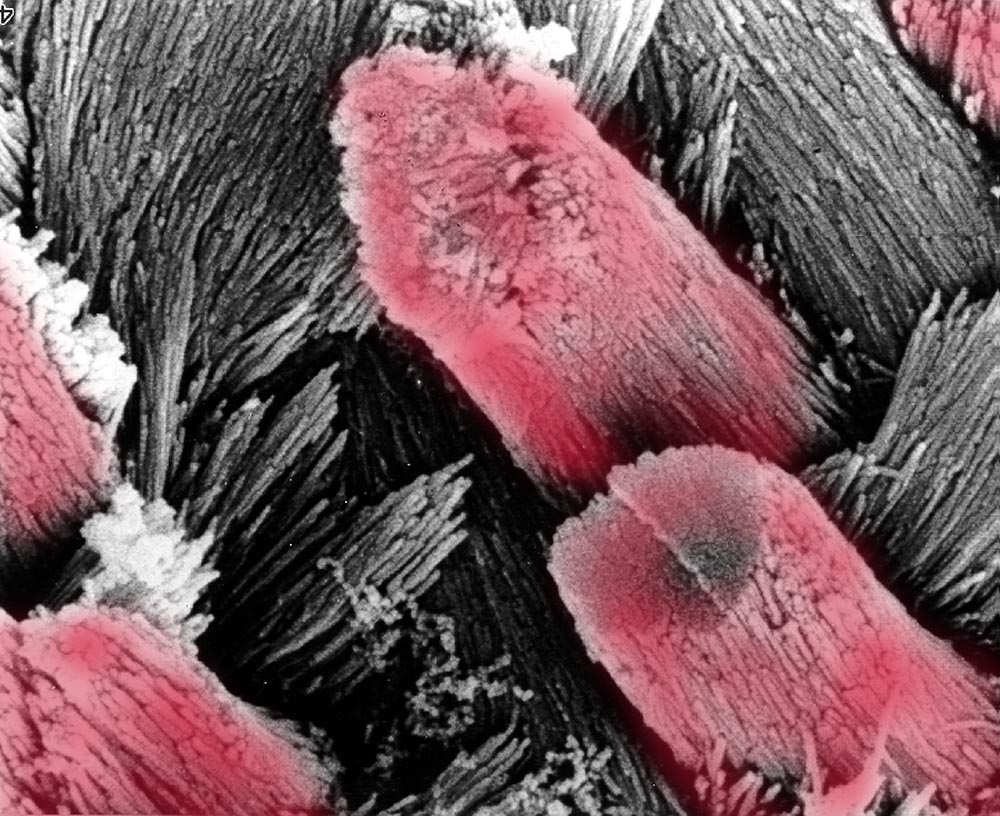
Tooth enamel viewed with a scanning electron microscope
Our lab is interested in determining the molecular mechanisms that govern enamel formation. Early on, we discovered the functional significance of supramolecular enamel matrix organization for enamel development (Diekwisch et al. 1993). We also demonstrated the independence of enamel deposits from adjacent dentin (Diekwisch et al. 1995).
In a series of evolutionary biology studies, we cloned and characterized a number of novel amelogenin genes, including frogs, salamanders, and iguanas in reptiles and amphibians (Wang et al. 2005, Diekwisch et al. 2006, Wang et al. 2006, Diekwisch et al. 2009, Wang et al. 2014). Based on these studies, we established polyproline repeat elongation as a mechanism for amelogenin aggregate compaction and enamel crystal elongation (Jin et al. 2009, PLoS Biology).
Finally, our lab reported the first complete 3D structure of the major tooth enamel protein, amelogenin (Zhang et al. 2011). Currently, we are asking how mineral ions are transported toward the enamel layer and what factors govern the nucleation and elongation of enamel crystals. Using an evolutionary biology approach, we are now studying the relationship between the amelogenin molecule and enamel mechanical properties.
Contributions to Journals
- Abramyan, J., Allan, M., Ding, Y., Lnu, N., Tang, L., Diekwisch, T.G.H. (2026). An Amelogenin Herbivore Motif, a Compacted Enamel Protein Matrix and Prismatic Enamel in Uromastyx Demonstrate Convergent Evolution in an Agamid Masticatory Apparatus. Evol Dev. 28(2): e70043.
- Lnu, N., Pandya, M., Luan, J., Ding, Y., Luan, X., and Diekwisch, T.G.H. (2026). The enamel matrix protein amelogenin is essential for enamel mineral transport and deposition. Stem Cells Dev. 35(5-6): 93-102.
- Diekwisch, T.G.H. (2022). Alan Fincham and the era of enamel protein biochemistry. Front Physiol. 13:1071265.
- Zhang, Y., Jin, T., Zhu, W., Pandya, M., Gopinathan, G., Allen M., Reed, D., Keiderling, T., Liao, X., and Diekwisch, T.G.H. (2022). Highly acidic pH facilitates enamel protein self-assembly, apatite crystal growth and enamel protein interactions in the early enamel matrix. Front Physiol. 13:1019364.
- Shaheen, J., Mudd, A.B., Diekwisch, T.G.H., and Abramyan, J. (2021). Pseudogenized Amelogenin Reveals Early Tooth Loss in True Toads (Anura: Bufonidae). Integr. Comp Biol. 61(5): 1933-1945.
- Diekwisch, T.G.H. (2020). Evolution: Herbivore-type teeth in a Cretaceous Tuatara relative. Curr Biology 30(9): R395-R397.
- Pandya, M., Lyu, H., Luan, X., and Diekwisch, T.G.H. (2021). Polarized, amelogenin expressing ameloblast-like cells from cervical loop/dental pulp co-cultures in bioreactors. Stem Cells Dev. 30(16):797-805.
- Jokisaari, J.R., Wang, C., Qiao, Q., Hu, X., Reed, D.A., Bleher, R., Luan, X., Klie, R.F., Diekwisch, T.G.H. (2019). Particle-Attachment-Mediated and Matrix/Lattice-Guided Enamel Apatite Crystal Growth. ACS Nano. 13(3): 3151-3161.
- Pandya, M. and Diekwisch, T.G.H. (2019). Enamel biomimetics: fiction or future of dentistry? Int. J. Oral Sci. 11(1):8.
- Klein, O.D., Duverger, O., Shaw, W., Lacruz, R.S., Joester, D., Moradian-Oldak, J., Pugach, M.K., Wright, T.J., Millar, S.E., Kulkarni, A.B., Bartlett, J.D., Diekwisch, T.G.H., DenBesten, P., and Simmer, J.P. (2017). Meeting report: a hard look at the state of enamel research. Int. J. Oral. Sci. 9(11): e3.
- Pandya, M., Lin, T., Li, L., Allen, M., Jin, T., Luan, X., and Diekwisch, T.G.H. (2017). Posttranslational amelogenin processing and changes in matrix assembly during enamel development. Front. Physiol. 8:790.
- Pandya, M., Liu, H., Dangaria S.J., Zhu, W., Li, L.L. Pan, S., Abufarwa, M., Davis, R.G., Guggenheim, S., Keiderling, T., Luan, X., and Diekwisch, T.G.H. (2017). Integrative temporo-spatial, mineralogic, spectroscopic, and proteomic analysis of postnatal enamel development in teeth with limited growth. Front. Physiol. 8:793.
- Pandya, M., Rosene, L., Farquharson C., Millán, J.L., and Diekwisch, T.G.H. (2017). Intravesicular phosphatase PHOSPHO1 function in enamel mineralization and prism formation. Front. Physiol. 8:805.
- Kirkham J., Brookes S.J., Diekwisch T.G.H., Margolis H.C., Berdal A., Hubbard M.J. (2017). Enamel research: Priorities and future directions. Front Physiol. 8:513.
- Liu, H., Yan, X., Pandya, M., Luan, X., and Diekwisch, T.G.H. (2016). Daughters of the enamel organ: Development, fate, and function of the stratum intermedium, stellate reticulum, and outer enamel epithelium. Stem Cells Dev. 25(20): 1580-1590.
- Lu, X., Fukumoto, S., Yamada, Y., Evans, C.A., Diekwisch, T.G.H., and Luan, X. (2016). The ameloblastin extracellular matrix molecule enhances bone fracture resistance and promotes rapid bone fracture healing. Matrix Biol. 52-54: 113-126.
- Lu, X., Fukumoto, S., Yamada, Y., Evans, C.A., Diekwisch, T.G.H., and Luan, X. (2016). Ameloblastin, an extracellular matrix protein, affects long bone growth and mineralization. J Bone Miner Res. 31(6): 1235-1246.
- Mao, Y., Satchell, P.G., Luan, X., and Diekwisch, T.G.H. (2016). SM50 Repeat- Polypeptides self-assemble into discrete matrix subunits and promote appositional calcium carbonate crystal growth during sea urchin tooth biomineralization. Ann. Anat. 203: 38-46.
- Gopinathan, G., Jin, T., Liu, M., Li, S., Atsawasuwan, P., Galang, M.-T., Allen, M., Luan, X., and Diekwisch, T.G.H. (2014). The expanded amelogenin polyproline region preferentially binds to apatite versus carbonate and promotes apatite crystal elongation. Front. Physiol. 5: 430.
- Goodwin A.F., Tidyman, W.E., Jheon, A.H., Sharir, A., Zheng, X., Charles, C., Fagin, J.A., McMahon, M., Diekwisch, T.G.H., Ganss, B., Rauen, K., and Klein O.D. (2014). Abnormal Ras signaling in Costello Syndrome (CS) negatively regulates enamel formation. Hum. Mol. Genet. 23(3): 682-692.
- Gopinathan, G., Jin, T., Liu, M., Li, S., Atsawasuwan, P., Galang, M.T., Allen, M., Luan, X., and Diekwisch, T.G.H. (2014). The expanded amelogenin polyproline region preferentially binds to apatite versus carbonate and promotes apatite crystal elongation. Front Physiol. 5: 430.
- Lucas, P.W., Casteren, A.v., Al-Fadhalah, K., Almusallam, A.S., Henry, A.G., Michael, S., Watzke, J., Reed, D.A., Diekwisch, T.G.H., Strait, D.S. and Atkins, A.G. (2014). The role of dust, grit and phytoliths in tooth wear. Annales Zoologici Fennici 51(1-2): 143-152.
- Wang, X., Xing, Z., Zhang, X., and Diekwisch, T.G.H. (2013). Alternative splicing of the amelogenin gene in a caudate amphibian Plethodon cinereus. PLoS ONE. 8(6): e68965.
- Atsawasuwan, P., Lu, X., Ito, Y., Chen, Y., Evans, C.A., Kulkarni, A.B., Gibson, C.W., Luan, X., and Diekwisch, T.G.H. (2013). Enamel-related gene products in calvarial development. J. Dent. Res. 92(7): 622-628.
- Lu, X., Ito, Y, Kulkarni, A., Gibson, C., Luan, X., and Diekwisch, T.G.H. (2011). Ameloblastin-rich enamel matrix favors short and randomly oriented apatite crystals. Eur. J Oral Sci. 119 Suppl 1: 254-260. Journal Cover.
- Zhang, X., Diekwisch, T.G.H., and Luan, X. (2011). Structure and function of ameloblastin as an extracellular matrix protein: Adhesion, calcium binding, and CD63-interaction in human and mouse. Eur. J Oral Sci. 119 Suppl 1: 270-279.
- Zhang, X., Ramirez, B., Liao, X., and Diekwisch, T.G.H. (2011). Amelogenin Supramolecular Assembly in Nanospheres Defined by a Complex Helix-Coil-PPII helix 3D-Structure. PLoS ONE. 6(10): e24952. doi:10.1371/journal.pone.0024952.
- Wright, T. and Diekwisch, T.G.H. (2011). Foreword, Enamel VIII. Eur J Oral Sci. 119 Suppl 1:x-xi.
- Diekwisch, T.G.H. (2011). Evolution and ameloblastin. Eur J Oral Sci. 119 Suppl 1: 293-297.
- Jin, T.*, Ito, Y.*, Luan, X., Dangaria, S., Walker, C., Allen, M., Kulkarni A., Gibson, C., Braatz, R., Liao, X., and Diekwisch, T.G.H. (2009). Supramolecular compaction through polyproline motif elongation as a mechanism for vertebrate enamel evolution. PLoS Biol. 7(12): e1000262. Featured in Science: ScienceNOW/ScienceShots December 2009.
- Diekwisch, T.G.H., Jin, T., Wang, X., Ito, Y., Schmidt, M.K., Druzinsky, R., Yamane, A., and Luan, X. (2009). Amelogenin evolution and tetrapod enamel structure. Front. Oral Biol. 13: 74-79.
- Wang, X., Fan, J.-L., Ito, Y., Luan, X., and Diekwisch, T.G.H. (2006). Identification and characterization of a squamate reptilian amelogenin gene: Iguana iguana. J. Exp. Zool. Mol. Dev. Evol. 306(4): 393-406.
- Diekwisch, T.G.H., Wang, X., Fan, J.-L., Ito, Y., and Luan, X. (2006). Expression and characterization of a Rana pipiens amelogenin protein. Eur. J. Oral Sci. 114 Suppl 1: 86-92.
- Wang, X., Ito Y., Luan, X., Yamane, A., and Diekwisch, T.G.H. (2005). Amelogenin sequence and enamel biomineralization in Rana pipiens. J. Exp. Zool. Mol. Dev. Evol. 304(2):177-186.
- Diekwisch, T.G.H., Berman, B.J., Anderton, X., Gurinsky, B., Ortega A.J., Satchell P.G., Williams, M., Arumugham C., Luan X., McIntosh J.E., Yamane A., Carlson, D.S., Sire, J.-Y., Simmer J.P., and Shuler, C.F. (2002). Membranes, minerals, and proteins of developing vertebrate enamel. Microsc. Res. Tech. 59(5): 373-395.
- Satchell, P.G., Anderton, X., Ryu, O.H., Luan, X., Ortega, A.J., Opamen, R., Berman, B.J., Witherspoon, D.E., Gutmann, J.L., Yamane, A., Zeichner-David, M., Simmer, J.P., Shuler, C.F., and Diekwisch, T.G.H. (2002). Conservation and variation in enamel protein distribution during tooth development across vertebrates. J. Exp. Zool. 294(2): 91-106.
- Satchell, P.G., Shuler, C.F., and Diekwisch, T.G.H. (2000). True enamel covering in teeth of the Australian lungfish Neoceratodus forsteri. Cell Tissue Res. 299(1): 27-37. Journal Cover.
- Thieberg, R.H., Yamauchi, M., Satchell, P.G., and Diekwisch, T.G.H. (1999). Sequential distribution of keratan sulfate and chondroitin sulfate epitopes during ameloblast differentiation. Histochem. J. 31(9): 573-578.
- Diekwisch, T.G.H. (1998). Subunit compartments of secretory stage enamel matrix. Connect Tissue Res. 38(1-4): 101-111.
- Zeichner-David, M., Vo. H., Tan, H., Diekwisch, T., Berman, B., Thiemann, F., Alcocer, M.D., Hsu, P., Wang, T., Reyna, J., Caton, J., Slavkin, H.C., and MacDougall, M. (1997). Timing of the expression of enamel gene products during mouse tooth development. Int. J. Dev. Biol. 41(1): 27-38.
- Diekwisch, T.G.H., Ware, J., Fincham, A.G., and Zeichner-David, M. (1997). Immunohistochemical similarities and differences between amelogenin and tuftelin gene products during tooth development. J. Histochem. Cytochem. 45(6): 859-866.
- Slavkin, H.C. and Diekwisch, T.G. (1997). Molecular strategies of tooth enamel formation are highly conserved during vertebrate evolution. Ciba Found Symp. 205: 73-80.
- Slavkin, H.C. and Diekwisch, T. (1996). Evolution in tooth developmental biology: of morphology and molecules. Anat. Rec. 245(2): 131-150.
- Fincham, A.G., Moradian-Oldak, J., Diekwisch, T.G.H., Lyaruu, D.M., Wright, J.T., Bringas, P., Jr., and Slavkin, H.C. (1995). Evidence for amelogenin “nanospheres” as functional components of secretory-stage enamel matrix. J. Struct. Biol. 115(1): 50-59.
- Moradian-Oldak, J., Simmer, J.P., Lau, E.C., Diekwisch, T., Slavkin, H.C., and Fincham, A.G. (1995). A review of the aggregation properties of a recombinant amelogenin. Connect. Tiss. Res. 32(1-4): 125-130.
- Zeichner-David, M., Diekwisch, T., Fincham, A., Lau, E., Mac Dougall, M., Moradian-Oldak, J., Simmer, J., Snead, M., and Slavkin, H.C. (1995). Control of Ameloblast Differentiation. Int. J. Dev. Biol. 39(1): 69-92.
- Diekwisch, T.G.H., Berman, B.J., Gentner, S., and Slavkin, H.C. (1995). Initial enamel crystals are spatially not associated with mineralized dentine. Cell Tissue Res. 279(1): 149-167. Journal Cover.
- Diekwisch, T.G.H., Marches, F., Spears, R., and Dechow, P. (1995). Effect of enamel protein expression on enamel crystal formation: a phylogenetic study. R.J. Radlanski and H. Renz (Eds.) Proc. 10th Int. Symp. Dent. Morph., Berlin 1995, pp. 82-87
- Fincham, A.G., Moradian-Oldak, J. Simmer, J.P., Sarte, P., Lau, E.C., Diekwisch, T., and Slavkin, H.C. (1994). Self-assembly of a recombinant amelogenin protein generates supramolecular structures. J. Struct. Biol. 112(2): 103-109.
- Diekwisch, T., David, S., Bringas, P., Santos, V. and Slavkin, H.C. (1993). Antisense inhibition of AMEL translation demonstrates supramolecular controls for enamel HAP crystal growth during embryonic mouse molar development. Development 117(2): 471-482.
- Diekwisch, T. (1989). Localization of microfilaments and microtubules during dental Development in the rat. Acta Histochem. Suppl. 37: 209-212.