

Strategic Plan, 2024-2029
Strategic Plan, 2024-2029

Justin Hopkin, MD
Division Chief, Hospital Medicine
I am happy to share our division’s 2024-2029 strategic plan. It is a culmination of a nine- month strategic planning process, where input from diverse voices across the division and beyond were garnered. The end product, resulting in four discrete goals with attainable and measurable objectives, sets a north star for the division in the coming years.
Our five-year strategic plan focuses on providing the highest quality of care to acutely ill patients, with additional attention on expanding our positive impact through best practices, strong interprofessional teams, and innovative scholarship. Over the next five years, the division will pursue care models to actively manage inpatient care effectively and efficiently including developing home- and community-based acute and post-acute care. Leaning into our strength of interprofessional teams, our division’s education offerings will continue to develop well-rounded clinicians, while our renewed commitment to research will grow our impact into the future.
As we launch this exciting new plan, I want to thank everyone in the division for their collaborative efforts creating the plan. As we move ahead implementing the plan, I look forward to collectively making positive advancements to benefit patients across Western New York!
Mission
Provide high-value, equitable care informed by science and healthcare innovation for acutely ill patients in western New York while fostering medical education and research to support the next generation of healthcare.
Values
- Enrichment and engagement
- Compassion and respect
- Integrity and accountability
- Excellence
- Creativity and innovation
- Well-being and growth
Vision
All acutely ill patients achieve optimal outcomes through compassionate, innovative academic medical care.
Strategic Goals
 Patient Care
- Deliver high quality care through efficient and safe workflows and processes.
- Enhance Behavioral Emergency Response Team (BERT) for patients with complex behaviors
- Implement tools to improve hospital through-put and ensure patients received the needed level of care by optimizing appropriate transfers, reducing readmissions, and identifying and supporting patients at high risk for against medical advice (AMA) discharge
- Develop effective processes for alternative level of care (ALC) patients to place them in appropriate post-acute settings
- Improve emergency planning for impacts of a disruption like a cyber-attack, loss of IT, and loss of a vendor
- Establish and monitor alternatives to inpatient care.
- Implement a hospital at home model
- Develop a post-acute home care model
 Education
- Provide cross-functional learning opportunities across URMC and the UR Medicine system.
- Create interprofessional learning opportunities for clinical teams
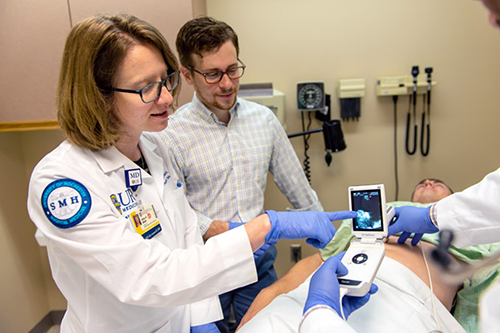
- Develop and formalize point of care ultrasound (POCUS) fellowship including curriculum, capstone project and certification
- Provide resources and education to regional affiliates
 Research
- Grow a research portfolio focused on transforming healthcare systems.
Support junior and mid-career faculty researchers as they grow their research portfolio
Generate scholarship by leveraging clinical initiatives such as co-management services, hospital at home and alternative care models