

News & Events
In the Division
Fueling Discovery: Meet the 2026 Research and Education Pilot Awardees
Tuesday, June 9, 2026
The Department of Medicine is brimming with innovative ideas for research, quality improvement, and scholarship. Each year, the department provides Research and Education Pilot Awards to help bring those ideas to fruition. Awardees receive $20,000-$40,000 to fund sustainable programs that will lead to further extramural funding, scholarly dissemination, and/or peer-reviewed publications.
Learn more about this year’s awardees, who will kick off their projects on July 1:
B Cell-Derived Pro-Fibrotic Factors Drive Myofibroblast Differentiation in Lupus Nephritis
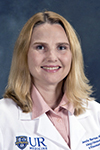
Jennifer Barnas, MD, PhD

Roukaya Yaakoubi, PhD
PIs: Jennifer Barnas, MD, PhD, and Roukaya Yaakoubi, PhD, of Allergy, Immunology, and Rheumatology
Mentor: Jennifer Anolik, MD, PhD, of Allergy, Immunology, and Rheumatology
Kidney involvement affects many patients with lupus and can lead to permanent kidney damage due to progressive scarring, or fibrosis. This project will explore a newly recognized role for B cells, which are known to produce autoantibodies and promote inflammation, in contributing to kidney fibrosis. Barnas and Yaakoubi will combine advanced analysis of kidney samples with laboratory studies using patient-derived B cells and human kidney cells to identify the signals that drive fibrosis and determine how B cells contribute to tissue remodeling. The findings could lead to more targeted therapies that prevent scarring while avoiding the broad immunosuppression associated with current B cell–depleting treatments.
Advancing Patient Autonomy Through HCP Documentation
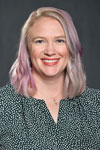
Catherine Glatz, MD

Paul Vermillion, MD
PIs: Catherine Glatz, MD, of Hospital Medicine, and Paul Vermillion, MD, of Palliative Care
Mentors: Ashley Jenkins, MD, MSc, of Hospital Medicine, and Janice Shriefer, MBA, MSN, DrPH, of Pediatrics
Almost half of hospitalized adults over 65 require a surrogate to help make medical decisions, but less than half of adults have a documented health care proxy. In New York, the Family Health Care Decisions Act outlines a hierarchy of decision-makers where no proxy is named, but their decisions can be challenged. Surrogate decision-making also places emotional and psychological burden on decision-makers.
This project aims to increase the percentage of patients with a health care proxy on file at the time of discharge. We will also investigate the barriers and facilitators to health care proxy documentation from the patient, caregiver, and healthcare professional perspective.
Understanding and Enhancing Peer Recovery Support Services in the Inpatient Setting for Adults with Substance Use Disorder
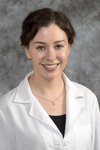
Elizabeth Pope-Collins, MD
PI: Elizabeth Pope-Collins, MD, of Hospital Medicine
Mentor: Ashley Jenkins, MD, MSc, of Hospital Medicine, and Marsha Wittink, MD, MBE, of Psychiatry
Hospitalization can be a moment where sick patients with substance use disorder are more motivated to initiate recovery or harm reduction practices. Leveraging this critical point can increase engagement in treatment and prevent further disability and death. Peer recovery support services are an under-studied intervention to encourage this engagement in care during hospitalization.
Pope-Collins will explore how patients, peers, and the rest of the medical team understand and experience peer recovery support services within University of Rochester Medicine to produce a local model of inpatient peer support grounded in realist and self-determination theory. She will also evaluate the national landscape of patient engagement strategies in substance use disorder to understand where her model exists in local and national contexts, laying the groundwork for future implementation studies.
Kidney Transplant Knowledge and Decision-Making Process in Older Population: Perceptions of Patients and Development of a Decision Support Tool

Hafsa Tariq, MBBS
PI: Hafsa Tariq, MBBS, of Nephrology
Mentors: Fahad Saeed, MBBS, of Nephrology, and Sandhya Seshadri, PhD, of Neurology
Older adults with end-stage kidney disease may benefit substantially from kidney transplantation, but they face unique risks and early post-transplant care burdens. Despite these tradeoffs, there is currently no shared decision-making tool designed for older adults, caregivers, and transplant clinicians that focuses on kidney transplantation.
This pilot study will explore older recipients’ and caregivers’ perspectives on kidney transplant education, knowledge gaps, and current decision-making practices through qualitative interviews. Findings will inform the development of a shared decision-making tool with input from patients, caregivers, and the multidisciplinary transplant team.
Cross-Division Expertise on Display at SGIM Meeting
Wednesday, May 13, 2026
Faculty and trainees from five DOM Divisions and both residency programs were among several thousand healthcare professionals, researchers who attended the Society of General Internal Medicine (SGIM) annual meeting. The meeting highlighted the importance of General Internal Medicine practitioners’ using their individual voices to advocate for excellence in academic medicine.
Our faculty and trainees presented work on a wide range of topics:
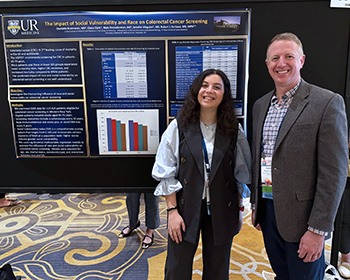
Charlotte Blumrosen, MD, and Robert Fortuna, MD,
with their poster.
Charlotte Blumrosen, MD, Medicine/Pediatrics resident, presented the poster "The Impact of Social Vulnerability and Race on Colorectal Cancer Screening," which she also recently published in Population Health Management. Robert Fortuna, MD, MPH, of Primary Care, is a coauthor.
Robert Fortuna, MD, MPH, of Primary Care, presented “Artificial Intelligence, Faculty Structure and Clinical Operations in Residency Practices: Insights from the 2026 Medical Directors Survey.”
Catherine Glatz, MD, of Hospital Medicine, organized and participated in a workshop called, "From Article to Advocacy: Harnessing Digital Media to Amplify Academic Voices."
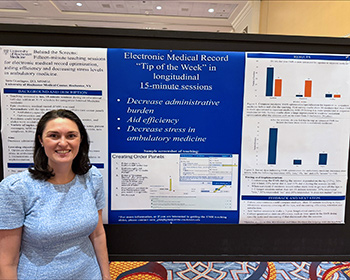
Sara Gianfagna, DO, with her poster.
Sara Gianfagna, DO, of General Medicine, presented the poster “Behind the Screens: Ten-minute teaching session for electronic medical record optimization, enhancing efficiency and decreasing stress in ambulatory medicine,” detailing implementation of her “Epic Tip of the Week” curriculum for residents.
Greg Russo, MD, Internal Medicine resident, presented the poster "Pulmonary Embolism Discharge Order Set Implementation to Improve Anticoagulation Adherence and Follow Up." DOM coauthors include Internal Medicine residents Genevieve Medina, MD, and Bisher Sultan, DO, as well as Dominick Roto, DO, of Pulmonary and Critical Care Medicine, and Sarah Rusnak, MD, of Hospital Medicine.
Elizabeth Pope-Collins, MD, of Hospital Medicine, organized and participated in a workshop called, "Bridging the Gap: Medicine Consultation Care of Psychiatrically Ill Patients"
Mahala Schlagman, MD, and Elizabeth Pope-Collins,
MD, on Capitol Hill.
Mahala Schlagman, MD, of General Medicine, took advantage of the meeting’s location near Washington, D.C., to meet with Rep. Joseph Morelle’s office on Capitol Hill to advocate for support for primary care in an upcoming physician payment reform package.
Jared Walsh, MD, our new chief of General Medicine, participated in a workshop called, "Taking the Pain Out of Chronic Opioid Prescribing: Coaching Residents in the Complexities of Long-Term Opioid Therapy" and presented the poster, "Scholarship Without Burnout: A Win-Win QI Model for Residents and Faculty."
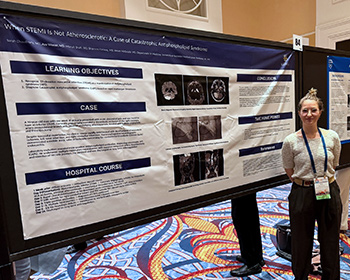
Ava Wexler, MD, posing at one of her posters.
Ava Wexler, MD, Internal Medicine resident, presented two posters: "When STEMI is Not Atherosclerotic: A Case of catastrophic Antiphospholipid Syndrome" and "The Peritoneal Carcinomatosis Mimic: Peritoneal Lymphomatosis Complicated by Spontaneous Tumor Lysis Syndrome." DOM coauthors includeKevin McGrody, MD, of Cardiology, Jainulabdeen Ifthikharuddin, MD, of Hematology & Oncology, Internal Medicine residents Sarah Choudhury, MD, Ashleigh Manktelow, MD, Manali Shah, DO, and Cardiovascular Disease Fellow Shamroz Farooq, MD.
Yousaf Ali, MD, of Hospital Medicine, Robert Fortuna, MD, MPH, of Primary Care, Rashmi Jasrasaria, MD, of General Medicine, and Kim Parkhurst, PhD, of Highland Hospital, also attended the meeting to learn from and support their peers and colleagues.