

Mechelle Sanders, PhD
Mechelle Sanders, PhD
 For healthcare professionals, resiliency is a familiar concept. It's reflected in the ability to adapt when circumstances change, overcome unexpected challenges, and maintain a sense of purpose even during the most difficult times. As a health equity researcher whose five-year NIH-funded grant was terminated a year early, Mechelle Sanders, PhD, knows first-hand about the importance of resiliency. For Sanders, it’s more than simply bouncing back from adversity; it's about learning, growing, and finding the strength to move forward.
“Even when the funding stops, the work must continue,” said Sanders. “The healthcare needs of our region are not going away. So, we have to get creative, adapt and pivot, and find ways to still make an impact for our community.”
Sanders grew up in Rochester and even as a child, she could see that where someone lived shaped the opportunities available to them. Those observations eventually became the foundation of a career focused on understanding why disparities exist and what can be done to address them.
“You can cross over one city street, and the health outcomes in one neighborhood are completely different than the outcomes in another,” Sanders explained.
Sanders earned her bachelor’s degree in psychology from Penn State University and then moved to New York City to become a teaching fellow. Working with children in the South Bronx gave her a new perspective on the relationship between social determinants, economic circumstances, education, and health. Many of her students dealt with significant trauma. For Sanders, being an educator meant embracing a responsibility that extended far beyond the classroom.
“I wanted my research to solve problems for children and families,” she said. “That’s what inspired me to become a health equity researcher. Just seeing the impact that the social determinants of health have kids’ education, I began thinking about how we can support kids, how we can support elders, and really thinking about the whole lifespan and how we can eliminate health disparities.”
Sanders joined the University of Rochester Medicine Department of Family Medicine as a research coordinator in 2007 and after more than a decade in that role, she earned her PhD in Health Services Research from University of Rochester in 2019. Today, Sanders is an assistant professor with a research focus on health equity, community engagement, and interventions designed to improve health outcomes.
The Importance of Health Literacy
In 2020, Sanders received a National Institutes of Health Career Development Award to conduct a study focused on improving health literacy. The multi-year grant funded a study led by Sanders titled, “Re-thinking the role of Peers And Training Patients [RePeAT].”
“What we find in the research is that patients with limited health literacy are less likely to talk about their health issues or have difficult discussions during visits with their clinicians,” Sanders said. To start the project, Sanders and her team trained six community health workers from different organizations to help patients build health literacy skills around cardiovascular health. Then they recruited 60 patients from the Department of Family Medicine who were considered at high risk for developing heart disease.
Patients were randomly assigned to one of two groups. Both received a booklet explaining the ABCs of heart health: taking aspirin when appropriate, controlling blood pressure, and managing cholesterol. The booklets also included information on quitting smoking. In addition, one group received a phone call from a community health worker to review the information.
During these calls, community health workers used a technique called “teach-back” to assess patients’ understanding by asking them to explain the ABCs in their own words. They also used motivational interviewing to help patients choose a heart-health goal, encouraged them to discuss that goal with their primary care clinician, and helped them address potential barriers to that conversation.
The research team audio-recorded patients’ next primary care visits, regardless of randomization group, to assess whether they brought up their ABC goals. Among patients who received the community health worker’s coaching call, 83 percent initiated an ABCs conversation with their clinician, compared with 25 percent of those who received only the booklet.
Grassroots Research: Taking it to the Streets
Sanders continues to work directly with community health workers and other grassroots organizations to reach people with limited or no access to a doctor.
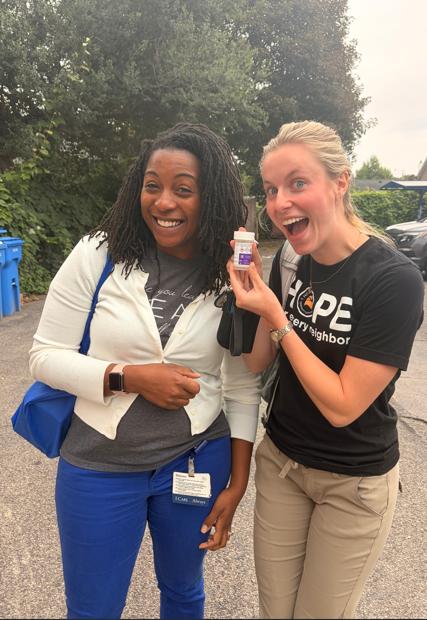 Sanders and Sophia Smith, a summer intern with the His Branches Street Medicine team, on their first day offering hrHPV self-collection.Sanders is partnering with a street medicine team to trial HPV self-sampling among women experiencing homelessness. Cervical cancer screening rates among women experiencing homelessness are an abysmal 19 percent, dramatically lower than the 74 percent among the general population. A new FDA-approved self-collection HPV test offers a potential way to remove some of the barriers associated with traditional screening.
“I've learned that a lot of the work has to happen where people live, work and play,” Sanders said. That realization has led to another project Sanders is leading to understand challenges associated with blood pressure monitoring for people experiencing homelessness. The idea of “home” blood pressure monitoring becomes complicated when someone doesn’t have a home.
Sanders is exploring partnerships with public libraries and street medicine providers to develop ways for people to monitor their blood pressure, access equipment, and receive support, even when they don't have a safe or permanent place to store a blood pressure monitor. It’s part of a larger vision Sanders has for Rochester in which healthcare for the unhoused does not always require a trip to a doctor's office or hospital. The library could become a place where someone gets help accessing a patient portal, uses a computer with internet connection, and has access to their health information without having to visit a traditional doctor’s office.
“I’m excited about bringing the work to the actual streets using the street medicine approach,” she said.
Navigating the healthcare system can be challenging for many people. Sanders has seen these pain points firsthand and is now going deeper into the community to understand the work of mutual aid coalitions. These groups help reduce healthcare disparities for people experiencing homelessness by meeting them where they live and improving access to food, essential supplies, and other resources that support health.
“I would like to see less friction for folks in terms of access and resources,” Sanders said. “We have a lot of gatekeepers in healthcare. I'd love to live in a place where the community can more seamlessly work with the healthcare system, so if we can figure out a way to do that, that would be outstanding.”