

Bush-Francis Catatonia Rating Scale Assessment Resources
Joshua Wortzel and Mark Oldham have developed the following educational resources on how to assess for catatonia using the Bush-Francis Catatonia Rating Scale (BFCRS) in collaboration with Andrew Francis.
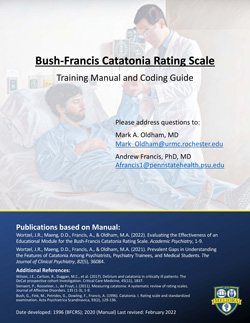
- BFCRS Training Manual & Coding Guide
Describes how to use the BFCRS and explains each item in detail. - Educational modules on using the BFCRS
Standardized patient videos and test questions with explanations. - Videos on scoring individual BFCRS items
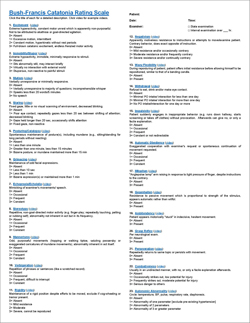
These can also be accessed from the PDF version of the BFCRS. - BFCRS calculator with descriptions & videos (mobile optimized)
Developed in collaboration with Patrick Ying.
Educational Modules on Using the BFCRS
Standardized patient videos and test questions with explanations.
Overview of Catatonia
Assessment Resources
Dr. Oldham and Dr. Wortzel provide a brief introduction to the training videos in the section below.
Standardized Patient Training Videos
The four standardized patient training videos below illustrate a full clinical assessment for the BFCRS. The first video depicts a patient without catatonia, followed by three videos assessing a patient portraying the three common motoric catatonia subtypes.
Normal Exam
This video features a standardized patient without catatonia to illustrate how to assess for all items on the BFCRS.
A description of the BFCRS Clinical Assessment can be found on pages 28–31 in the BFCRS Training Manual & Coding Guide.
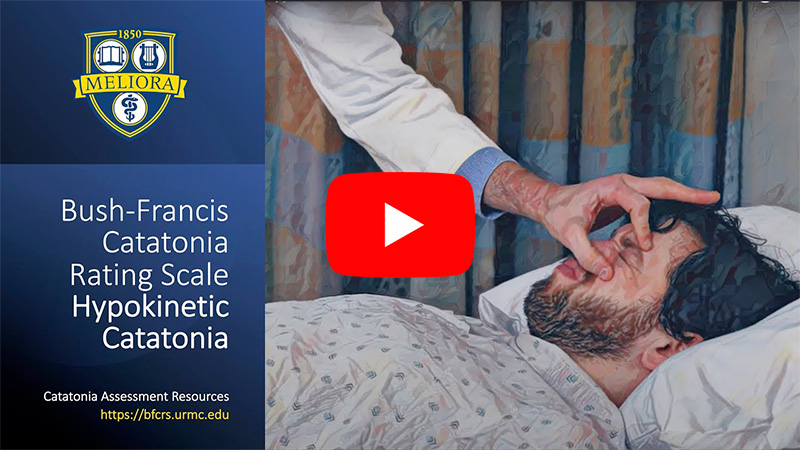
Hypokinetic Catatonia
Assessment of a standardized patient portraying catatonia's hypokinetic motoric subtype.
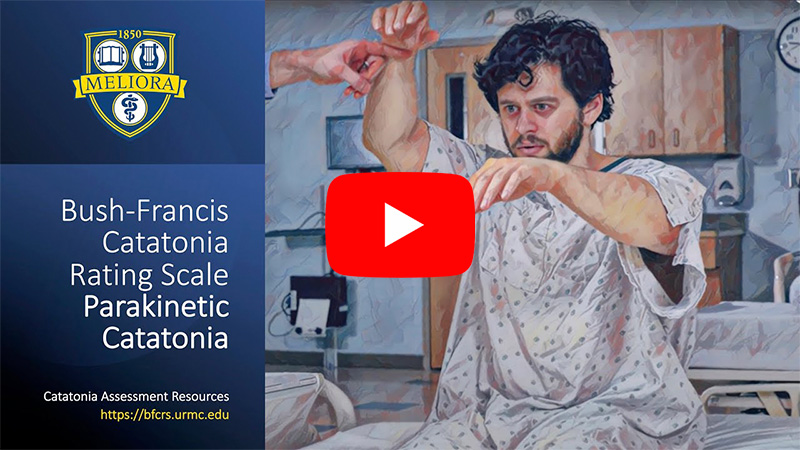
Parakinetic Catatonia
Assessment of a standardized patient portraying catatonia's parakinetic motoric subtype.
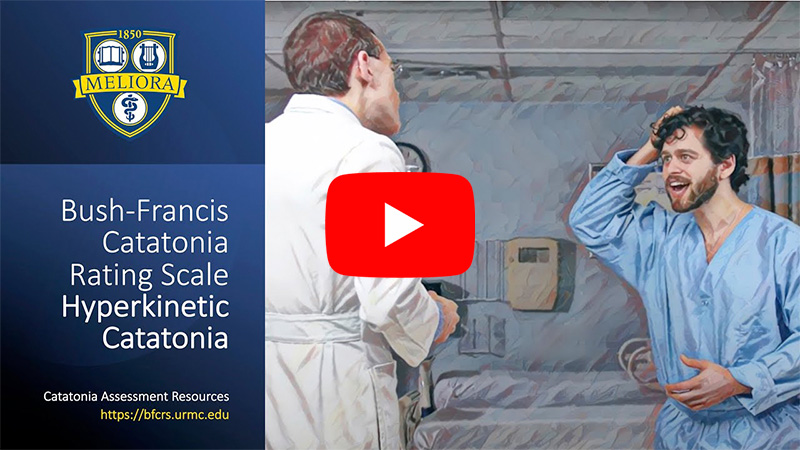
Assessment of a standardized patient portraying catatonia's hyperkinetic motoric subtype.
How to Score Individual BFCRS Items
The following videos demonstrate how to score the first six BFCRS items.
Watch videos for all BFCRS items
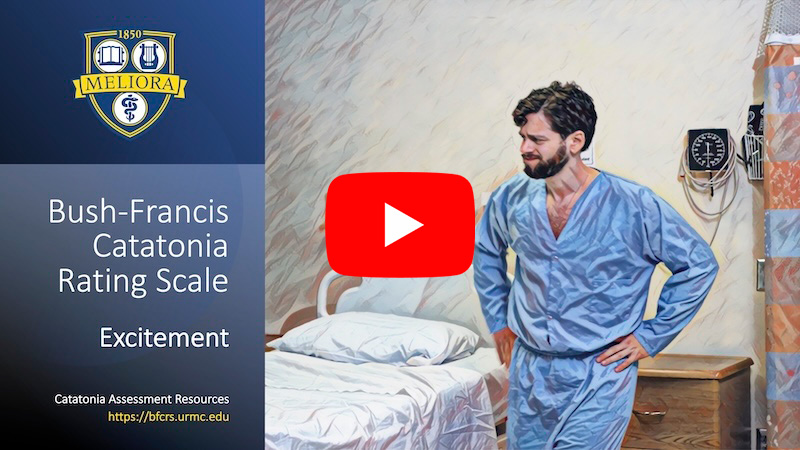
Excitement
Extreme hyperactivity, constant motor unrest which is apparently non-purposeful. Not to be attributed to akathisia or goal-directed agitation.
0 = Absent
1 = Excessive motion, intermittent
2 = Constant motion, hyperkinetic without rest periods
3 = Full-blown catatonic excitement, endless frenzied motor activity
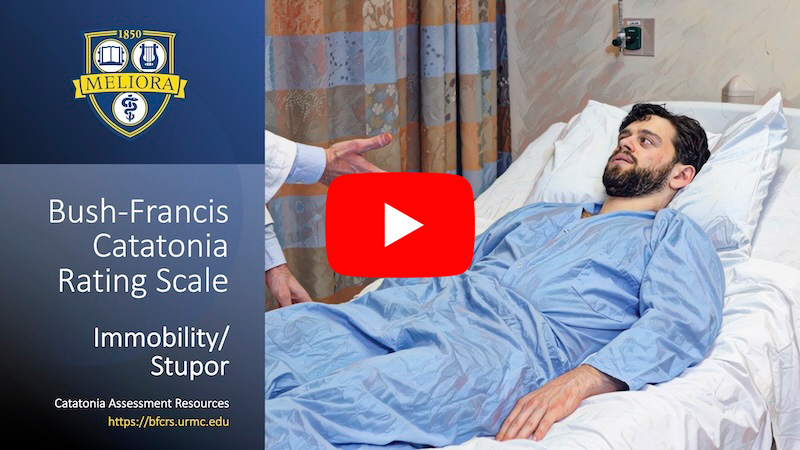
Immobility / Stupor
Extreme hypoactivity, immobile, minimally responsive to stimuli.
0 = Absent
1 = Sits abnormally still, may interact briefly
2 = Virtually no interaction with external world
3 = Stuporous, non-reactive to painful stimuli
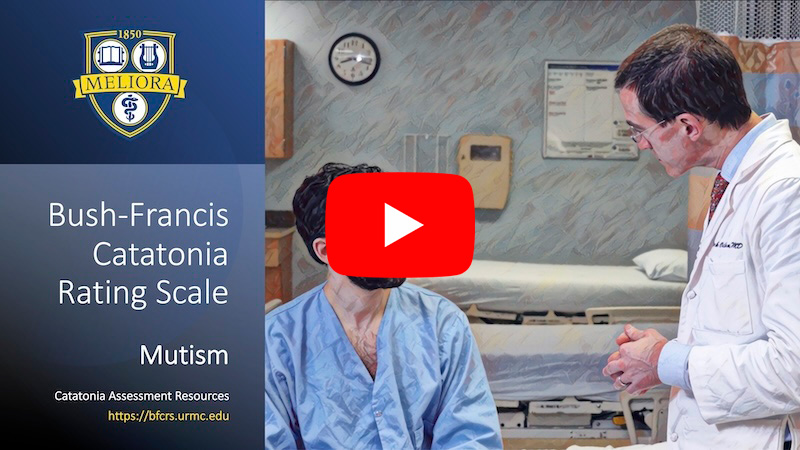
Mutism
Verbally unresponsive or minimally responsive.
0 = Absent
1 = Verbally unresponsive to majority of questions
2 = Speaks only rarely
3 = No speech

Staring
Fixed gaze, little or no visual scanning of environment, decreased blinking.
0 = Absent
1 = Poor eye contact, decreased blinking
2 = Fixed gaze most of time
3 = Continuous staring, unresponsive
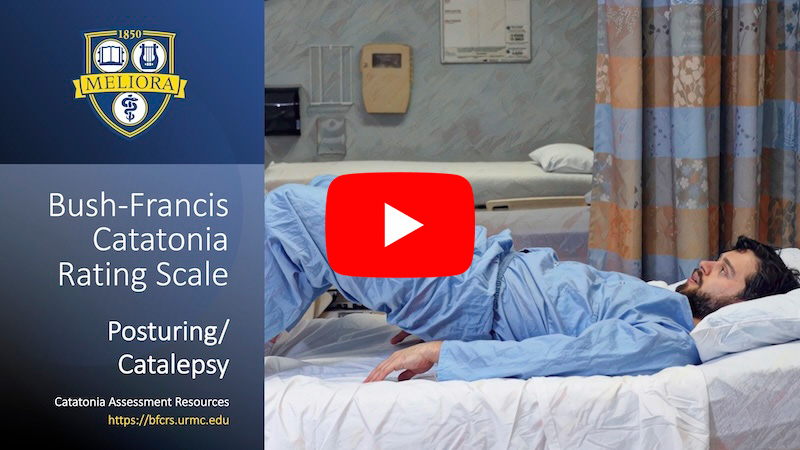
Posturing / Catalepsy
Spontaneous maintenance of posture(s), including mundane postures held for long periods.
0 = Absent
1 = Mild or brief posturing
2 = Clear posturing for extended periods
3 = Extreme or bizarre posturing
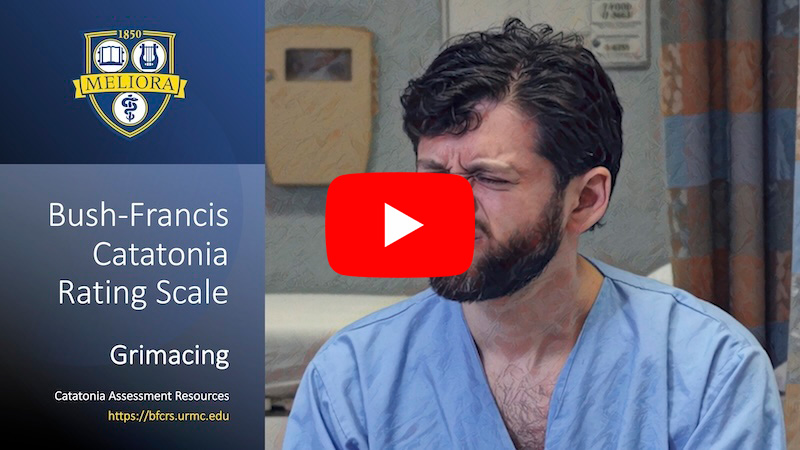
Grimacing
Maintenance of odd facial expressions.
0 = Absent
1 = Occasional grimacing
2 = Frequent grimacing
3 = Sustained grotesque expressions
References
Wortzel JR, Maeng DD, Francis A, Oldham MA. Evaluating the Effectiveness of an Educational Module for the Bush-Francis Catatonia Rating Scale. Acad Psychiatry. 2022;Jan 7 (online):10.1007/s40596-021-01582-0.
Wortzel JR, Maeng DD, Francis A, Oldham MA. Prevalent gaps in understanding the features of catatonia among psychiatrists, psychiatry trainees, and medical students. J Clin Psychiatry. 2021;82(5):21m14025.
Rogers JP, Oldham MA, Fricchione G, Northoff G, Wilson JE, Mann SC, Francis A, Wieck A, Wachtel LE, Lewis G, Grover S, Hirjak D, Ahuja N, Zandi MS, Young AH, Fone K, Andrews S, Kessler D, Saifee T, Gee S, Baldwin D, David AS. Evidence-based consensus guidelines for the management of catatonia: Recommendations from the British Association for Psychopharmacology. J Psychopharmacol. Online April 11, 2023.
Oldham MA. Describing the features of catatonia: A comparative phenotypic analysis. Schizophr Res. 2023; in press: 10.1016/j.schres.2022.08.002.
Bush G, Fink M, Petrides G, Dowling F, Francis A. Catatonia. II. Treatment with lorazepam and electroconvulsive therapy. Acta Psychiatr Scand. 1996; 93(2):137-143.
Bush G, Fink M, Petrides G, Dowling F, Francis A. Catatonia. I. Rating scale and standardized examination. Acta Psychiatr Scand. 1996;93(2):129-136.
Contact Us
Joshua Wortzel, MD, MPhil
Hartford Healthcare and Yale School of Medicine
Email Dr. Wortzel
Mark Oldham, MD
Associate Professor of Psychiatry,
University of Rochester, Department of Psychiatry
Email Dr. Oldham
Additional Resources
Catatonia Information Center
Directed by Dr. Andrew Francis
Catatonia Resources hosted by University College London
Directed by Drs. Jonathan Rogers and Anthony David
So That’s What Catatonia Looks Like?
Narrative review of this project published in Psychiatric Times
Finding catatonia requires knowing what to look for
This MDedge News article provides guidance on converting BFCSI items to DSM-5-TR