menu

Appendix

School of Medicine and Dentistry – Graduate Programs

Fall 2025
August 25 (Monday)Classes Begin
September 1Labor Day (No Classes)
September 5

Last day to add/drop courses in without permission from course director

September 22

Last day to add/drop courses with permission from the course director. Last day to request courses be changed to an audit status.

September 23First day to Withdraw (“W”) from a course
October 13 – 14

University Fall Break (NOT a break for Graduate Students)

November 10Last day to Withdraw (“W”) from a course
November 26 – November 30Thanksgiving Recess
December 1Classes Resume
December 8Last Day of Class
December 9 – 11Reading Days
December 12 - 17Final Exams
December 23Final Grades Due
Spring 2026
January 20 (Tuesday)Classes Begin
January 23 (Friday)

Rochester “Monday” – all students attend Monday classes

January 30

Last day to add/drop courses in without permission from course director

February 16

Last day to add/drop courses with permission from the course director. Last day to request courses be changed to an audit status.

February 17First day to “W” from a course
March 7 – 15

University Spring Break (NOT a break for Graduate Students)

April 13Last day to Withdraw (“W”) from a course
May 1Last Day of Class
May 2 – 4Reading Days
May 5 – 10Final Exams
May 14 (Thursday)Final Grades Due
May 15 - 17Commencement Weekend
Summer 2026
May 18 – July 31Full Summer Session
May 25 (Monday)Memorial Day Observed (No Classes)
June 19 (Friday)Juneteenth Observed (No Classes)
July 3 (Friday)Independence Day Observed (No Classes)


widget-handbook-faculty

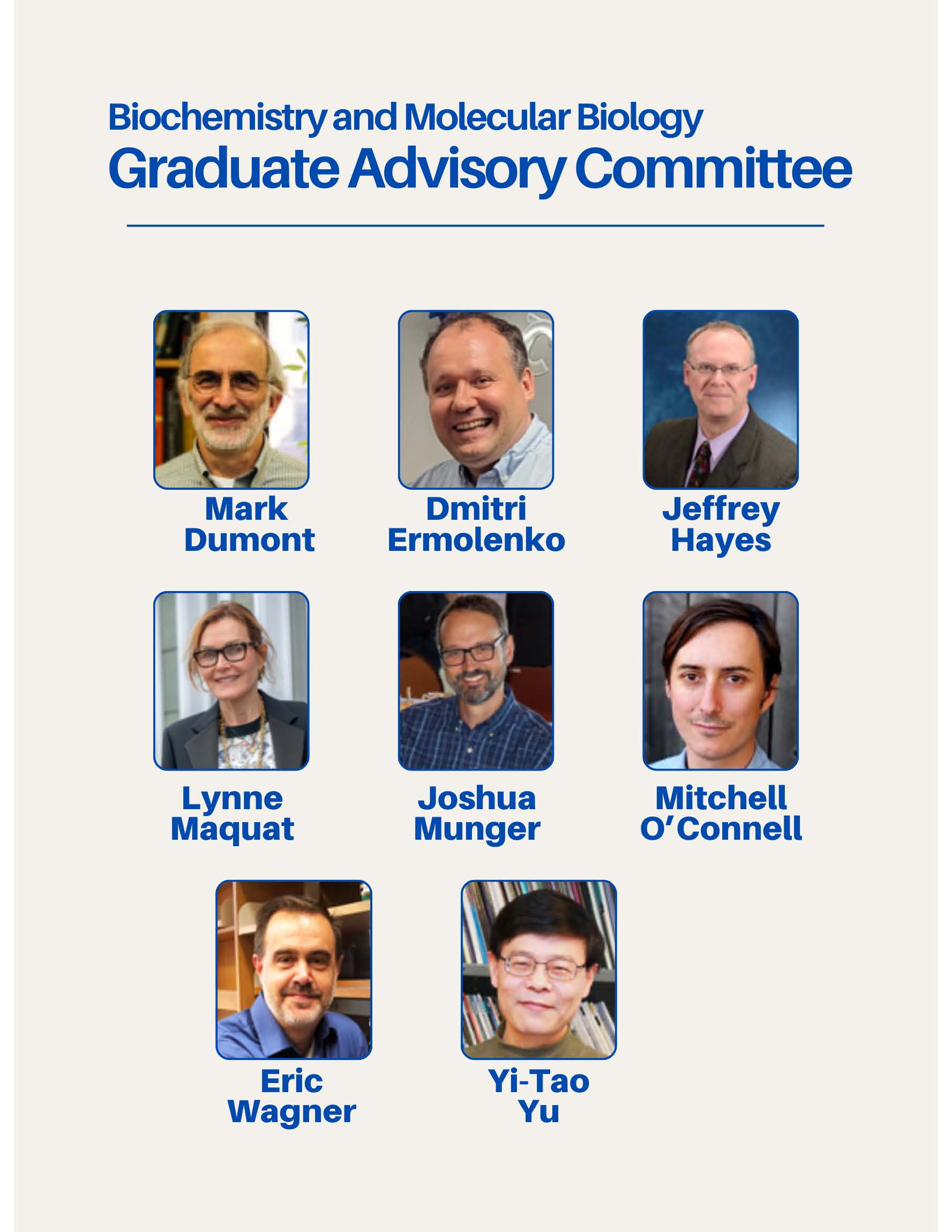
2026 BMB Faculty Advisory Committee Members

Fall 2025

BCH 515 CRITICAL THINKING IN RESEARCH SCIENCE (1)

Students present a history of experimental work leading to their research project. This includes a selection of published and unpublished work from their advisor's lab and other labs in the same field, providing a rationale for the project. Students conclude with a report of their published and preliminary data. Focus will be on interpreting experimental data and engaging student interactions.

BCH 517 TOPICS IN CELLULAR, BIOCHEMICAL AND MOLECULAR SCIENCE (1)

Students attend presentations in the Department of Biochemistry and Biophysics Seminar Series. Instructors and students select speakers and read 2-3 publications (suggested by the speaker) in depth. Students present these papers to the class, instructors and the speaker's faculty host in a journal club se[ng prior to the speaker's arrival. Finally, students attend a post-seminar class with the selected speaker.

BCH 521 BIOINFORMATICS FOR LIFE SCIENTISTS (4)

This course will teach scripting in Python and also algorithm design for bioinformatics. It expects no prior knowledge in programming. The class will meet twice a week – once for a traditional lecture and once for a laboratory session.

BCH 570 MULTILAYERED CONTROL OF GENE EXPRESSION

We will meet once per week (1.5 hours/session) for this literature-based course meeting, where students read and discuss research papers describing how, in higher eukaryotes, gene expression is shaped by mulJple and ocen interconnected layers of regulaJon. The instructor has selected recent research papers that illustrate how given regulators may influence different steps of gene expression and how these steps cooperate to robustly control gene expression. The purpose of this course is to familiarize students with current models of gene expression and with contemporary research methodologies through student-led discussions of publications in the field. This is an advanced biochemistry course intended for senior undergraduate and graduate students. Students are expected to read the papers before class and participate in the classroom discussion

BIO 422 BIOLOGY OF AGING (4)

This course focuses on molecular mechanisms of aging. We will discuss popular theories of aging, model organisms used in aging research, evolution of aging, relation between aging and cancer, human progeroid syndromes, and interventions to slow aging.

BIO 426 DEVELOPMENTAL BIOLOGY (4)

This course deals with the cellular and molecular aspects of animal development, with emphasis on processes and underlying mechanisms. Topics include embryonic cleavage, gastrulation, early development of model vertebrates and invertebrates, patterning of cell fates along embryonic axes of Drosophila and vertebrates, organogenesis and stem cells.

CHM 411 INORGANIC CHEMISTRY I (4)

This course covers bonding in inorganic molecules, molecular symmetry, an introduction to solid-state chemistry, coordination chemistry and the properties of transition metal complexes. Two 75 minute lectures per week, 7 workshops, 6 problem sets, three midterm examinations and a final examination.

CHM 415 GROUP THEORY (2)

Development of symmetry and group theory concepts and scope of applications to chemical problems. Applications include molecular orbital theory, ligand field theory and spectroscopy. (Fall, 1st half of semester.)

CHM 423 NMR SPECTROSCOPY (2)

(Formerly CHM 422) - An introduction to NMR spectroscopy. Collection, processing, and interpretation of homonuclear and heteronuclear 1D and multidimensional spectra will be covered. Topics to be discussed include chemical shifts, relaxation, and exchange phenomena. Examples from organic, inorganic, and biological chemistry will be used. (Fall, 1st half of semester).

MBI 473 IMMUNOLOGY (3)

This lecture-based course will cover basic concepts in development and function of the immune system, including innate immunity and inflammation, adaptive T and B lymphocyte responses, immunity to infection, vaccination, tumor immunotherapy, transplantation, allergy, and autoimmunity. Small group meetings will be held weekly to discuss open-ended problems based on recent lectures. Students will be evaluated by three exams.

PHP 403 HUMAN CELL PHYSIOLOGY (4)

This course is aimed at providing an introduction to the fundamental principles of stem cell biology, modern cell physiology, tissue and organ physiology, and intercellular communication. Initially the course will provide the implications of cellular and molecular principles for stem cell biology. Subsequently, the remainder of the course will focus on the integrated physiological responses and intercellular signaling of cells, tissue systems, and intact organs in both healthy and diseased states. The material will include basic concepts, principal research questions, and common methodologies ‐ emphasis will be on a quantitative approach wherever possible. Critical reading and evaluation of recent literature relevant to each major topic will be an integral part of the course. This essential skill, key to the success of any burgeoning research scientist, will be thoroughly assessed through participation in the weekly “Paper” sessions.

BST 463 INTRO TO BIOSTATISTICS (4)

Introduction to statistical techniques with emphasis on applications in the health sciences. Summarizing and displaying data; introduction to probability; Bayes' theorem and its application in diagnostic testing; binomial, Poisson, and normal distributions; sampling distributions; estimation, confidence intervals, and hypothesis testing involving means and proportions; simple correlation and regression; contingency tables; use of statistical software. 

BST 464 APPLIED LINEAR REGRESSIONS (4)

One-way and two-way analysis of variance; multiple comparisons involving means; fixed and random effects; simple and multiple linear regression; analysis of covariance; interactions; correlation and partial correlation; multicollinearity; model selection; model checking.

PTH 507 CANCER BIOLOGY (3)

The lectures will provide historical perspectives of cancer incidence, treatment, and early scientific inquiry as a foundation for understanding the current state of cancer research. Leading basic and translational scientists will discuss the genetic basis of cancer in both familial cancer syndromes and acquired somatic mutations. Research on the normal cellular functions such as cell cycle control, apoptosis, and signal transduction that become aberrant in cancer progression will also be discussed. Additionally, the mechanism of chemical and viral induction of cancer will also be explored. The second half of the course will focus on clinical identification and treatment of cancer as well as the mechanism of therapeutic action in prevention of carcinogenesis. Lectures from leading clinician scientists will provide insight for cancer treatment with goals of understanding the human impact of the disease and identifying common themes, as well as distinctive characteristics of cancer.

Spring 2026

BIO 415 MOLECULAR BIOLOGY OF CELL SIGNALLING (4)

This course offers an introduction to cell signaling. We will explore basic molecular mechanisms of signal transduction, and study how these mechanisms are used in different contexts to direct cell fate during development, physiology and disease. The course will draw heavily on experiments from the classic and most recent primary literature.

BIO 453 COMPUTATIONAL BIOLOGY (4)

An introduction to the history, theory, and practice of using computers to conduct biological research. Topics include the fundamentals of Linux-based computing and perl programming, accessing and storing biological data, alignment of molecular sequences, and computer-based analysis of data.

BPH 411 METHODS IN STRUCTURAL BIOLOGY (2)

An introduction to the theory and practical application of several major techniques used in the structural characterization of biological macromolecules. These methods include: X-ray crystallography, Small Angle X-ray Scattering, Spectroscopic and Calorimetric Techniques, NMR and Comparative Modeling. The goal is to enable non-specialists to become conversant in the language and principles of the field, as well as to understand the strengths and limitations of various techniques. This course is a prerequisite to the literature-based course BPH592, “Advanced Topics in Biomolecular Diffraction and Scattering”. Non-majors should also consider BCH 412 “Advanced Topics in Biological Macromolecules”. Offered for the first half of the Spring semester.

BPH 509 MOLECULAR PHYSICS (2)

This course is designed to show how physical concepts and techniques are used to explore and understand biological phenomena. A major portion of the term focuses on thermo- dynamics of biological molecules and systems; the remainder covers the structure and physical properties of biological membranes and transport. Students are expected to have had basic courses in physics, chemistry, and biology, with an in-depth background in at least one of these areas. Offered for the second half of the Spring semester.

CHM 440 BIO ORGANIC CHEMISTRY (4)

(Formerly CHM 437) An introduction to bioorganic chemistry and chemical biology. The course will present a survey of how the principles of organic chemistry have been applied to understand and exploit biological phenomena and address fundamental questions in life sciences. The course is primarily based upon the primary literature. Covered topics include the design and mechanism of enzyme mimics and small molecule catalysts (organocatalysts), synthesis and chemical modification of biomolecules (oligonucleotides, proteins, and oligosaccharides), design and application of oligonucleotide and peptide mimetics, and chemical approaches to proteomic and genetic analyses. Not open to freshmen and sophomores.

GEN 507 ADVANCED GENETICS AND GENOMICS (4)

This course offers in-depth discussions of theoretical concepts and experimental strategies in genetics and genomics. Lectures will cover genetically tractable model organisms, including yeast, Drosophila, Caenorhabditis elegans (a nematode), mouse, and human and their analyses from gene to genome and systems level. Examples of the particular questions that can be addressed with advantage in each genetic model will be presented, and the special genetic approaches feasible in these respective systems will be emphasized. The course builds upon a strong prior background in Mendelian and molecular genetics. Topics covered include the genetic basis of pattern formation, cell-fate determination, control of cell function, structure-function relationships in macromolecules, and searching for genes important in human health. Additional topics incorporated recently into the course include genome structure & evolution, small RNAs & mobile genetic elements, epigenetics and genomics, proteomics, and other studies at the whole genome level.

IND 419 Introduction to Quantitative Biology (3)

This is a graduate-level survey course that introduces concepts for the analysis of high volume biological data in the context of important current biological questions. No previous computational experience is required. Course Aims and Objectives: At the end of this course, students should have a deeper understanding of the computational tools involved in the analysis of high volume biological data, focusing on web-based resources but also introducing core approaches in bioinformatics. As an advanced-level course, we will emphasize critical thinking and reading of the primary literature to understand original experiments, rather than abstract facts and memorization. Students’ knowledge, understanding and ability to formulate new ideas will be evaluated through homework and discussions. 

IND 443 EUKARYOTIC GENE REGULATIONS (4)

This advanced course examines mechanisms of chromatin-mediated regulation of gene expression, relating molecular structures, dynamic interactions, nuclear processes, 3-D nuclear organization to biological functions. Topics include DNA structures, packaging and higher order chromatin organization in the nucleus, the transcription machinery, eukaryotic chromosome structure and its modifications, epigenetics and functional genomics, dynamics of nuclear processes, nuclear reprogramming, development and applications of genome manipulation technology. Lectures and readings draw heavily on primary literature both classic and most recent.

IND 447 SIGNAL TRANSDUCTION (4)

Cellular signal transduction is one of the most widely studied topics in the biomedical sciences. Cells have multiple mechanisms for sensing the environment and converting the external signals into intracellular responses that are important for regulation of human physiology. Dysregulation of these processes can result in disease and manipulations of these pathways are the basis for many therapeutics.

MBI 421 MICROBIAL GENETICS (3)

This course provides an in-depth examination of representative genetic systems in bacteria and bacterial viruses. Emphasis is placed on the methods of genetic analysis used to study biological function. The material covered includes: the nature of bacterial variation, processes affecting gene synthesis and integrity, the nature of gene transfer in bacteria, the regulation of gene expression in prokaryotes and genomic approaches to the study of microbial genetics. (Graduate students register for MBI 521 Seminar).

MBI 456 GENERAL VIROLOGY (4)

Provides an introduction to animal virology, with emphasis on human disease. Topics covered include the following: general properties of viruses, methods in viral research, virus structure, biochemistry of virus replication, virus- host cell interactions, pathogenesis, HIV/AIDS, emerging infections, vaccines, antivirals, and viral vectors and gene therapy. Three exams.

PHP 404 PRINCIPLES OF PHARMACOLOGY (4)

Pharmacology is one of the vital disciplines in biomedical sciences. It employs the multidisciplinary knowledge in biochemistry, cell biology, chemistry, genetics, neuroscience, pathology, physiology, toxicology, and clinical medicine, to elucidate the mechanisms of action of drugs in treating human diseases. This course represents a collective endeavor of our faculty to the teaching of graduate and senior undergraduate students in UR. It focuses on the fundamental principles of pharmacology, neuropharmacology, cardiovascular pharmacology, and contemporary approaches to drug discovery and design.

Number of Credits

The specific number of research credits for which a student will enroll varies from one semester to another, generally increasing in number as students progress through their respective programs and complete the required and elective didactic coursework. Students may register for this course for a minimum of 1 and maximum of 16 credits.

Course Instructor

The instructor will be a faculty member who is qualified to supervise the PhD research of the student (i.e., the research advisor).

Course Description

Students will conduct mentored independent research in pursuit of a doctoral dissertation. This research will include applying experimental, computational, and/or analytical methods to advance their mentored research project. Students will properly document their work and communicate it through meetings, presentations, and/or in the pursuit of manuscripts. 


Prerequisites

Dissertation research is restricted to students who are currently enrolled in a PhD graduate program and who are in good academic standing.

Aims and Objectives

Aims and objectives will vary, depending on the program and level of research training. In general, students will make significant progress toward the following:

  • Acquire and maintain, as appropriate to the stage of the student’s research, a thorough understanding of the existing foundational knowledge related to the research project
  • Develop novel research avenues that have the potential to significantly advance the field
  • Identify available and applicable research-related resources
  • Acquiring the requisite technical knowledge to further develop the research project
  • Continuing training in the responsible conduct of research
  • Demonstrate understanding of the various aspects of the research process and critical evaluation of research project outcomes
  • Develop a dissertation research proposal
  • Prepare sufficient documentation to ensure the reproducibility of the research
  • Complete a draft dissertation chapter (or chapters) as appropriate to the stage of research
  • Prepare work for dissemination to the broader research community (i.e., manuscripts, conferences, presentations)

Doctoral Learning Outcomes and Assignments

This semester-long course involves mentored independent research as part of progress toward completion of a dissertation, which represents the conclusion of doctoral training upon successful defense. Knowledge, research and scholarship, communication, and professional development support the mission of graduate education.

  • Knowledge of core concepts and principles of the specific discipline within the student’s chosen program of study
  • Research and scholarship skills to define a specific problem or unanswered question, describe studies conducted to gather necessary data or develop methodology to address this problem or question, describe approaches to analyze and interpret the data obtained or to assess the methodology, and discuss the implications of these findings
  • Ability to communicate results of research, scholarship, and performance to colleagues and the public through oral/audiovisual and written work
  • Preparation and development for immediate integration into the professional career for which the student has been trained

Assignments

Research credit is given for specific activities, including but not limited to: planning and executing experiments or other appropriate studies, analyzing data, preparing and delivering presentations, reading the literature, participating in laboratory or research team meetings, writing manuscripts, and collaborating on the projects of other research team members. Activities appropriate to the student’s research projects will be assigned by the course instructor. Students are accountable for meeting the expectations of their research mentor(s) (i.e., the course director) and committees, and the standards of ethical conduct and academic integrity that are set by the University of Rochester.

Methods of Assessing Student

Grade out of 100%

  • 40% Research effort- Effort will be measured based on participation in research activities as co-developed by the course director and the student.
  • 40% Research progress- Research progress will be measured based on any/all of the following: generation of tangible research products (abstracts, papers, figures, protocols, code, etc.), demonstration of technical mastery (acquisition of new abilities, or significant improvement in regard to data generation or gathering, statistical analysis, etc.), and intellectual development (completion of literature review, hypothesis generation, writing a research plan or study outline, etc.).
  • 20% Research annotation and communication- This portion of the grade will be based on the student following appropriate record keeping policies and taking part in activities designed to disseminate research (abstracts, papers, presentations, journal clubs, etc.)

Evaluation of performance in these criteria should be provided in the form of written feedback and discussed with the student as part of their annual (or semi-annual) evaluation. 

Basis of Grade Determination

Students will receive one of the following grades:

A Very good to Excellent

A- Good

B+

B Marginal

C-

C Unsatisfactory

E

Per the SMD Grade Policy, grades of B- or better are required for satisfactory performance in the PhD program. One grade below B- in any course or research experience is cause for review of overall performance and will result in academic probation for the duration of graduate study. A second grade below B- is basis for dismissal from the PhD program. Official Grade Policy

A grade below B+ (marginal) may trigger additional review of the student’s effort/progress by their respective graduate program.

Course Policies and Expectations

Research Effort

Research effort should be sufficient to facilitate steady progress toward research or other professional goals, and align with credit hour guidelines set by the State of New York. For example, a total of 6 credit hours is approximately equivalent to 270-360 hours over a semester (19-20 hrs/week); 16 credit hours is approximately equivalent to 720-960 hours over a semester (40-55 hrs/week).

Per SMD policy, students are permitted to take two weeks of vacation time (10 business days) each calendar year in addition to official University holidays. For details, visit Vacation and Holiday Policy

Semester breaks are not considered holidays. Students are expected to inform the course director of their vacation schedule well in advance.

Unexpected absences for illness, family emergencies, etc. require prompt notification of the course director. Unexplained absences of a chronic or continuous nature may result in an unsatisfactory grade for this course.

Regular Meetings

Attendance at all pre-arranged meetings with the course director, committee members, and program director are mandatory. Students are expected to discuss their meeting schedule with the course director. The course director will determine the exact number of one-on-one meetings that will take place with the student during the semester. It is expected that the student and the course director will communicate regularly and that the student will meet with the course director at least once every two weeks. If a student must miss a pre-arranged meeting for any reason, prior notice is required. If prior notice is not possible, notification should be provided as soon as possible.

Conduct of Research

Students are expected to abide by the University’s policy on Research Misconduct. Students are expected to adhere to any state, local, or University safety policies relevant to their research environment. Students are required to complete periodic training in biological safety, animal, and human research as necessary for their research project.

Resources

The required materials for dissertation research will depend on each student’s thesis project and graduate program requirements. Students will work on an independent research project under the supervision of the course director and will document their research in accordance with the University’s dissertation manual. Students will be expected to comply with the University of Rochester’s instructions on writing and formatting a thesis document upon approval by the student’s committee to commence writing.

https://www.rochester.edu/graduate-education/academic-resources/dissertation-manual/


Note: Committee meetings are for the student and should be student-driven. Doctoral mentors should refrain from speaking over or for the student and should play an accessory role during the committee meeting.

I. The Committee meeting should be held immediately after the student seminar, or as soon after the seminar as it can be scheduled.

II. The Research Review Form should be distributed to all members of the thesis committee at least two working days prior to the scheduled committee meeting.

III. The purposes of the thesis committee meeting are to:

  • determine whether the student is making adequate progress in the lab.
  • determine whether the student has accumulated sufficient background knowledge of his or her field to provide a context for the ongoing project
  • identify possible deficiencies and strengths of the student’s previous and planned research strategies
  • provide technical assistance to help the student overcome roadblocks
  • assess the feasibility and goals of the student’s immediate and longer-range research plans
  • facilitate the planning and preparation of manuscripts
  • establish a timeline for graduation
  • provide guidance regarding the student’s post-degree career planning

IV. Meetings should be scheduled for 2 hours with all committee members present (although they can end up being shorter than that). Note: If a faculty member unexpectedly misses the student’s seminar, the student should meet with them individually prior to the committee meeting to apprise them of their progress

    A rough schedule of the agenda for thesis committee meetings is as follows:

  1. (~5 minutes) The student will be asked to leave the room to allow the committee to meet with the advisor.
  2. (20-60 minutes) The student may present a short (~15-30 min) overview showing data accumulated since the last TAC and summarizing where their research project stands and their plans for continuing the project. The committee may ask about other material presented in the student seminar that requires clarification.
  3. (0-30 minutes) The student may present any additional pertinent aspects of their project that were not discussed in the student seminar.
  4. (15 minutes) The student will discuss short- and long-range plans for continuing the project and plans for publication.
  5. (10 minutes) The student will discuss plans for graduation and solicit input from the committee on post-graduation career planning.
  6. (5-10 minutes) The student will be asked to leave the room a second time while the committee decides on the evaluation of progress and discusses suggestions and critiques to be added to the Research Review Form.
  7. (5-10 minutes) The student will rejoin the committee and the advisor will leave the room to allow the committee to discuss any concerns that the student may have about work environment and research progress.

V. After the meeting, the advisor will incorporate the committee’s critiques and suggestions into the Research Review Form and circulate the form to all members of the committee for approval.

VI. The final approved Research Review Form will be sent to the BMB program administrator, to all committee members, and to the office of the Associate Dean for Graduate Studies.


Please reach out to Marianne Arcoraci for the electronic copy of the following forms:

  • Research Rotation Evaluation – Faculty Form
  • Research Rotation Evaluation – Student Form
  • Rotation Request form
  • Annual Ph.D. Student Evaluation Report
  • First-Year Evaluation Rubric
  • Thesis Approval Form
  • Request for Chairperson
  • Guidelines for the Content of a Basic Science Ph.D. Thesis
  • Qualifying Exam Rubric

Primary Faculty

Paul Boutz
Research Interest: Regulation of pre-mRNA splicing and polyadenylation in healthy and diseased states; the contribution of RNA processing to cancer biology; effects of small molecule drugs on RNA processing and gene expression.
Mark Dumont
Research Interest: Signal transduction; membrane protein structure, yeast molecular biology
Dmitri Ermolenko
Research Interest:

Structural dynamics of the ribosome and ribosomal ligands during proteins synthesis, regulation of protein synthesis by mRNA structure in normal and diseased cells, and mechanisms of antibiotic action.

Barry Goldstein
Research Interest:

Crystallography and structural chemistry of enzyme-ligand interactions.

Elizabeth Grayhack
Elizabeth Grayhack, Ph.D.
Research Interest:

Role of the genetic code in regulating protein synthesis and mRNA metabolism in Saccharomyces cerevisiae.

Alan Grossfield
Research Interest:

Investigating membranes and membrane proteins via computer simulation

Jeffrey Hayes
Research Interest: Regulation of transcription, nuclear processes, related to chromatin structure and function
Jermaine Jenkins
Research Interest:

X-ray crystallography and cryo-electron microscopy analysis of RNA and protein-RNA complexes

Clara Kielkopf
Research Interest: Splicing defects in hematologic malignancies; roles of human pre-mRNA splicing factors in HIV-1 infectivity; development of engineered splicing factors for correction of splicing defects; splice sites and their associated proteins as therapeutic targets.
Lynne Maquat
Research Interest:

Nuclear and cytoplasmic RNA metabolism in mammalian cells: Co- and post-transcriptional pre-mRNA processing; influence of pre-mRNA splicing on mRNA metabolism, including the structure and function of modular exon-junction complexes and effects of AKT-signaling; Nonsense-mediated mRNA decay; Fragile X Syndrome (FXS)/Autism/Intellectual disabilities; mRNP Structure and function in non-polar cells and in neurons; Development of FXS therapeutics.

David Mathews
Research Interest: Computational biology of RNA, including structure prediction, molecular dynamics, and genomics.
Joshua Munger
Research Interest: Mechanisms of metabolic network manipulation induced by viral infection and oncogenic mutation.
Mitchell O'Connell
Research Interest: Biochemical mechanisms of RNA-mediated gene regulation; RNA-targeting CRISPR tool development
Makaía Papasergi-Scott
Research Interest:

Molecular mechanisms and spatiotemporal regulation of G protein-coupled receptor (GPCR) signaling pathways using cryo-electron microscopy (cryo-EM), biochemical, and pharmacologic studies; instrumentation and methods development in cryo-EM; structural biology of RNA/protein therapeutic targets and treatments.

Eric Phizicky
Research Interest: tRNA biogenesis, function and quality control; intellectual disability due to deficiencies in tRNA modifications.
Gaëlle Talross
Research Interest:

Long non-coding RNA–micropeptide systems in neuronal function, sensory biology, and behavior.

Eric Wagner
Research Interest:

Mechanism and physiological importance of alternative polyadenylation; Integrator Complex and transcriptional control, development and application of next-generation sequencing technologies

Joseph Wedekind
Research Interest: Structure and function analysis of gene regulation by non-protein-coding (nc)RNAs as a basis for therapeutic development.
Yi-Tao Yu
Research Interest: RNA modification; pre-mRNA splicing; snRNP biogenesis; telomerase RNA modification and aging; nonsense-disease therapeutics.

Research Faculty

Javeed Bhat
Javeed Bhat, Ph.D.
Ashok Kumar
Ashok Kumar, Ph.D.
Rina Nagao
Rina Nagao, Ph.D.
Bogdan Polevoda
Research Interest: The two cotranslational processes, cleavage of N-terminal methionine and N-terminal acetylation (N- acetylation).
Shalom Rackovsky
Research Interest:

Computational protein biophysics, bioinformatic approaches to protein folding and dynamics, development of novel methods of biomolecular sequence and structure comparison and analysis.

Elena Rustchenko-Bulgac
Elena P. Rustchenko-Bulgac, Ph.D.
Research Interest:

Chromosomes instability of human fungal pathogen Candida albicans.

Bradley Smith
Research Interest:

Director of the Metabolomic Resource lab

Kyle Swovick
Research Interest:

Mass Spectrometry Resource Laboratory

Hironao Wakabayashi
Hironao Wakabayashi, M.D., Ph.D
Research Interest:

Structural and functional analyses of factor VIII

Secondary Faculty

Michael Bulger
Michael D. Bulger, Ph.D.
Research Interest:

Chromatin domains and long-range activation by enhancers

Gloria Culver
Research Interest: Assembly of the E. coli 30S ribosomal subunit, which is essential for cellular growth, so as to understand how infections might be controlled through selective inhibition of specific assembly control points.
Chin-To Fong
Research Interest: Genetics of orofacial clefts
Hartmut Land
Research Interest: Molecular mechanisms of carcinogenesis. Signaling and Cancer Cell Metabolism
Benjamin Miller
Research Interest:

Research in the Miller group centers on (1) photonic sensors, particularly with regard to continuous monitoring of microphysiological systems and biomanufacturing; (2) medical diagnostics, including paper-based point-of-care and self-tests for RNA viruses.

Peng Yao
Research Interest:

Pathophysiological function and molecular mechanism of new non-coding RNAs and RNA-binding proteins and translational control in cardiac system and cardiovascular disease

Emeritus Faculty

Robert Bambara
Research Interest: Human genome stability, DNA damage response, HIV replication and evolution
Scott Butler
Research Interest: Regulation of Gene Expression by Targeted Degradation of RNA
Mahin Maines
Research Interest:

Heme oxygenases and second messenger gases: CO and NO.

Terry Platt
Research Interest:

Molecular mechanisms of gene expression; transcription termination and mRNA 3' and formation in Escherichia coli and yeast; protein-nucleic acid.

Alan Senior
Research Interest: Multidrug-resistance in cancer; ATP synthesis in bacteria and mitochondria
Harold Smith
Harold C. Smith, Ph.D.

Research Interest:

Msg RNA editing in health and disease