

Becoming a Scientific Writer
Becoming a Scientific Writer
Course Introduction | Resources for Scientific Writers

This Photo by Unknown Author is licensed under CC BY.
Course Contents
Modules are provided as MS Word documents. If you would like these modules in PDF format, please contact Connie Baldwin at constance_baldwin@urmc.rochester.edu. Note: Appendices are in MS Word only (to enable practice activities and module evaluations).
Module 1. Think Like a Writer
App. 1: Module 1 Evaluation Form
Module 2. Writing Sentences: Word Choice and Sentence Structure
App. 1: Sentence Examples in Module 2
App. 2: Additional Sentences for Practice Revisions
App. 3: Module 2 Evaluation Form
Module 3. Writing Paragraphs: Focus, Order, Sequence, and Continuity
App. 1: Paragraph Examples in Module 3
App. 2: Additional Paragraphs for Practice Revisions
App. 3: Module 3 Evaluation Form
Module 4. Research Articles From Start to Finish
App. 1A and 1B: Guidelines for Writing Quantitative and Qualitative Research Articles & Article Planning Worksheet
App. 2: Educational Scholarship Article
App. 3: Discussion Section of a Systematic Review Article (+ Revision Summary Table)
App. 4: Program Evaluation Article
App. 5: Research Article on Perinatal Palliative Care Services
App. 6: Module 4 Evaluation Form
Module 5. Writing Winning Grant Proposals
App. 1: Guidelines for Writing and Reviewing an NIH R01 Grant Proposal
App. 2: Assessing Your Proposal for Coverage of NIH Review Criteria
App. 3: K23 Entire Proposal
App. 4: ROI Rationale for Research Design
App. 5: K23 Aims Significance and Preliminary Data
App. 6: Module 5 Evaluation Form
Module 6: Mastering Productivity and Fighting Procrastination
App. 1: Module 6 Evaluation Form
Course Introduction
My Background

Constance D. Baldwin, Ph.D.
Professor of Pediatrics
I have been teaching scientific writing for over four decades. This was not my original plan when I earned a PhD in English at Stanford University. But as a graduate student, I found that I loved teaching writing to Stanford freshmen. Later I discovered that in academic medicine and biomedical science, the need for writing instruction was (and remains) enormous. So for me, this was a happy alignment of the stars.
Since 1985, my career has been focused on faculty development in scientific communications and educational scholarship. I developed my first scientific writing course in the Department of Pediatrics at the University of Texas Medical Branch at Galveston (Version 1.0 of this course!). In 2005, I continued this work when I joined the University of Rochester Medical Center as a Professor of Pediatrics. Since 2014, I have served as Co-Director of the General Academic Pediatrics Fellowship Program, which has a strong emphasis on research and publication. I have mentored dozens of faculty and fellows, including physicians, basic scientists, and educators, on writing papers and grant proposals. Teaching about writing and writing about teaching have been the cornerstones of my career.
Creating the Course
I originally delivered the course modules on sentence and paragraph writing (2 and 3) as a highly interactive 8-hour workshop. I gave it over 20 years to annual women’s professional development conferences sponsored by the Association of American Medical Colleges (AAMC). Later, I turned my slides into an online authoring course for early career educators in the Educational Scholars Program of the Academic Pediatric Association. (I was the founding director for this program and led it from 2006 to 2016.)
Participants’ enthusiastic reviews of my presentations on sentence and paragraph writing led me to supplement my “Nuts and Bolts of Scientific Writing” workshops with materials from my many other workshops on writing articles and grant proposals, and on writing productivity. The result of these efforts is Becoming a Scientific Writer. I have delivered elements of the course at my home institutions, at other academic centers, and at many national meetings. I know that a written course cannot be as interactive as live workshops, but I have tried to make the modules as interactive as possible.
Module 1 offers tips on thinking like a writer, particularly keeping a focus on the needs of your reader while you write. We continue in Module 2 to consider writing good sentences, and in Module 3 to combine sentences into effective paragraphs. In these two modules, I have used sentences and paragraphs that need revision, so you can benefit from hands-on practice in editing. The appendices for Modules 2 and 3 will set you up for this practice with sentences and paragraphs in Word format.
Next, in Modules 4 and 5, we put these basic components of writing together by strategically planning and composing scientific articles and grant proposals. In the appendices, I offer models of well-written papers and proposals donated by my mentees to help you get started writing these challenging documents. I provide editorial comments to help you understand what makes these examples work well. All were accepted for publication or for grant funding.
I saved until Module 6 my advice to help you enhance your writing productivity, including strategies to fight procrastination and its co-conspirator, perfectionism. You procrastinators are welcome to begin this course with Module 6!
Learning to Self-Edit Through Interactive Practice Exercises
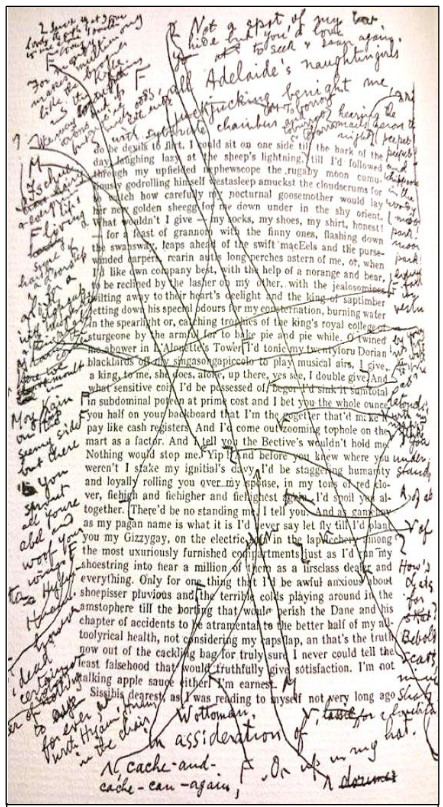
James Joyce’s edits of a page from Ulysses
Novel Gazing – Galley proof of “Ulysses”, corrected by James Joyce
– via @RupertThompson1 | Facebook
Here you can view an example of self-editing from the novelist James Joyce. He was editing the supposedly “final” galley proof of his famous novel, Ulysses. Needless to say, the publishers were less than pleased to have to reset the type! Nonetheless, you can see that Joyce was determined to perfect his language. (Some colleagues said that he was never finished editing.)
Because self-editing is essential to good writing, you can learn important skills by editing the writings of others. I have chosen “unperfected” practice sentences and paragraphs as examples that are typical of early draft documents. Editing these samples is a critical part of the course, if you seriously aim to improve your writing skills. The interactive components of Modules 2 and 3 focus on these practice sentences and paragraphs, which we will discuss and revise during the modules. Copies of these practice examples in MS Word format can be found in the appendices for Modules 2 and 3. As you progress through the modules, I recommend that you use the appendices to first try out the revisions on your own, and then compare your revisions with mine.
For further practice, I have created in the appendices for both modules additional practice sets of “early draft” sentences and paragraphs, plus my revisions. I believe that this activity is a highly effective way to improve your own self-editing skills. I hope you will transfer this practice to editing your own documents.
My Goals for the Course
This course is designed to help scientific writers master the complex forms, content and modes of argument used in scientific articles and grant proposals. I aim for writers to clearly explain complex ideas, persuade readers with effective arguments, and achieve technical skill in writing with accuracy, clarity, brevity, and elegance. I also hope they will develop writing habits that lead to academic productivity.
I try to teach from a positive perspective, but here at the start of my course, I must acknowledge that scientific writing is intrinsically challenging. First, it is complex in content and logic, and accurate expression of this complexity requires a demanding combination of clarity and brevity. (The need for brevity is of course dictated by journal and grant proposal requirements.) Second, the standards for scientific writing are exacting. This is a high stakes game, with rigorous peer review and critical consequences for authors.
These writing challenges may sound intimidating, but think about it from the reader’s perspective. If writing is not clear, the reader may waste too much energy interpreting the structure of sentences to be able to capture the meaning. If the sentence structure is faulty, or paragraphs lack a clear sequence of ideas, your meaning may be impenetrable. Most readers will make an effort to get the writer’s point, but they are always free to just move on to an article that is easier to read, and often they do just that. However, take heart! I can testify that inexperienced writers can and do improve, and that is the purpose of this course.
For the aspiring scientific writer, I hope that this interactive course will give you a useful starting point for good writing and efficient self-editing. I wish you the best in your future writing efforts!
 Learning Objectives for Becoming a Scientific Writer
- Describe qualities of good scientific writing
- Identify common writing faults that create barriers to a reader’s understanding
- Write clear, concise, and effective prose at the level of sentences and paragraphs
- Describe the form, content, and modes of argument conventionally used in scientific articles and grant proposals
- Use strategies that drive the persuasive presentation of ideas in scientific articles and grant proposals
- Develop successful writing habits for academic writing productivity
Each module includes as a final appendix an evaluation form in MS Word format. Please complete it on your computer and email to: constance_baldwin@urmc.rochester.edu. Your input will help me to improve this course!
A Short List of Resources for Scientific Writers
The following resources were important to me in developing this writing course. I hope they will be useful to you, as well. Both the printed and online materials will lead you to a wealth of additional resources. I am sure you can add to these lists as your education in writing progresses.
In Print
Boice R. Professors as Writers: A Self-Help Guide to Productive Writing. New Forums Press, 1990 Boice is an authority on writing productivity.
Cook DA. Twelve tips for getting your manuscript published. Medical Teacher, 38:1, 41-50, 2016. Overall strategies, rather than how-to’s.
Day RA and Sakaduski N. Scientific English, A Guide for Scientists and Other Professionals, 3rd Edition. Greenwood, Santa Barbara CA, 2011. Good for definitions and simple explanations of grammatical and syntactical terms. Note in particular Appendix 2: Problem Words and Expressions, and Appendix 3: Words and Expressions to Avoid.
Garner BA. Garner's Modern English usage. Oxford University Press, 2022. All about grammar!
Gastel B and Day RA. How to Write and Publish a Scientific Paper, 9th Edition. Greenwood, Santa Barbara CA, 2022. A standard text.
Gopen GD and Swan JA. The Science of Scientific Writing. American Scientist, 78: 550-558, 1990. Very good on organization of ideas into sentences and paragraphs.
Huth EJ. Writing and Publishing in Medicine. Williams & Wilkins, Philadelphia PA, 1999. I particularly like Ch. 12, Revising Prose Style.
Lynch J. The English Language: A User’s Guide. Hackett Publishing, 2015.
Parsell G and Bligh J. AMEE Guide No. 17: Writing for journal publication. Medical Teacher, 21:5, 457-468, 1999. Emphasizes the pre-planning process.
Strunk Jr W and White EB, illustrated by M Kalman. The Elements of Style (Illustrated), 5th Edition. Penguin Books, New York, NY, 2007. An inspiring, BRIEF argument for the value of clarity and brevity in prose. This is a classic that practices what it preaches. (This fifth edition includes charming illustrations, but previous editions contain much the same content.)
Taylor R B. The Clinicians Guide to Medical Writing. Springer Science & Business Media, 2006. A practical and realistic, but positive approach to writing as a physician.
Tufte ER. The Visual Display of Quantitative Information. Graphics Press, Cheshire CT, 2001. Complex and elegant.
Kate L. Turabian (Author), Wayne C. Booth, Gregory G. Colomb, Joseph M. Williams, Joseph Bizup, William T. FitzGerald, and Univ of Chicago Editorial Staff (Editors). A Manual for Writers of Research Papers, Theses, and Dissertations, 9th Edition. Chicago Guides to Writing, Editing, and Publishing, University of Chicago Press, Chicago IL, 2018. A classic writers’ manual, updated in this edition for the digital age.
Zeiger M. Essentials of Writing Biomedical Research Papers 2nd Ed. McGraw-Hill, New York, 2000. An excellent writing workbook.
Online
How to Write a Paper in Scientific Journal Style and Format, On‐line Resources Website. v. 10‐2014. Greg Anderson, Bates College Department of Biology. Lewiston, ME. This website focuses on biological science writing.
A Writers’ Handbook, Writing Center @ the University of Wisconsin-Madison
Guide to Grammar and Style, by Jack Lynch (see also Lynch book above)
Guide to Grammar and Writing, Professor Charles Darling and the Capital Community College Foundation.
English as a Second Language (Purdue)
Sources of Images
Unless otherwise noted, the images used in this course are from Microsoft Office Online Photos and Clip Art. They are allowed to be used with credit, but without need for permission, when used for non-commercial purposes.